“It can hardly be argued that either students or teachers shed their constitutional rights at the schoolhouse gate,” Supreme Court Justice Abe Fortas stated. In the eyes of the law, students have the same rights as anyone else in the United States.
This includes the right the Founding Fathers of America fought for: to be represented by their governing body.
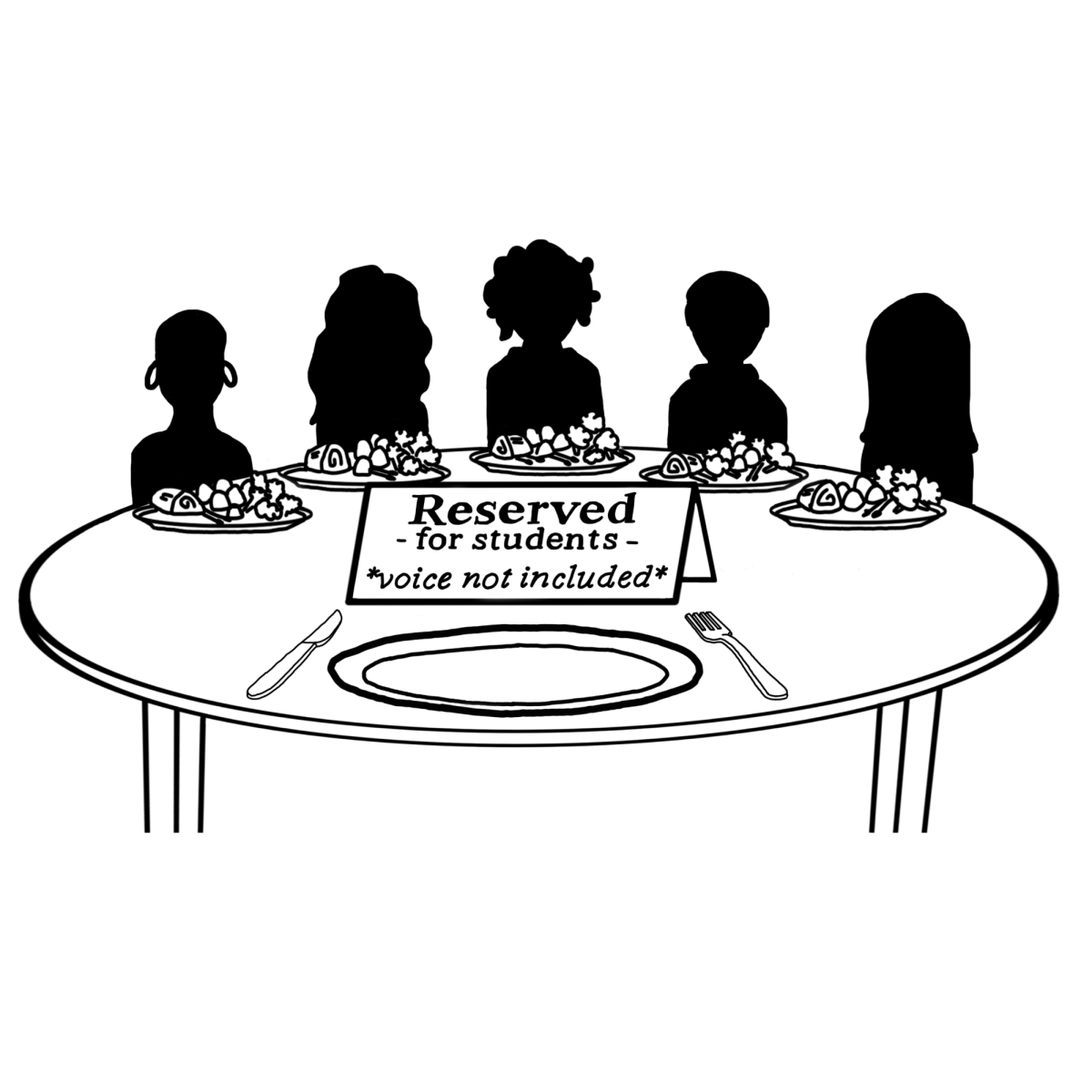
Yet the mechanisms used by governing bodies to hear student voices have failed. Students have a seat at the table, but are not allowed to eat.
This is exemplified by the Tamalpais Union High School District (TUHSD) board, a sample of what occurs everyday on the world stage.
According to our district’s YouthTruth survey, only 31 percent of TUHSD students feel they have a say in how things are run across campuses. This information was presented to the board as one of the “greatest challenges” found in the survey, yet no action or discussion has occurred on the topic.
Youth voices are tokenized at every level of government, and the most obvious local example of this is how the TUHSD school board treats their student board members.
Student board members are given a brief training on how the board works yet are not taught their full rights, including the right to cast a preferential vote which is a formal (yet non-binding) expression of the wishes of the student body, mandated by California law. No TUHSD student board member has ever cast one.
During the March 10 board meeting, the student board members from Archie Williams and Tamalpais High School were both interrupted during their updates to trustees. Helen Kay, the Tamalpais student representative, started her speech by advising the students from Archie Williams who spoke on behalf of the TEAM program to share their speeches with the Archie Williams student trustee. She was interrupted by Cynthia Roenisch, who stated, “Could you please update us on what’s happening at Tam?”
Evelyn Jones, the Archie Williams student trustee began to speak on the cutting of TEAM program to which Roenisch responded, “I’m going to interrupt because the student trustee reports are supposed to be telling us what’s going on on campus…so while we respect what people said, we’re not here to review it.”
Evelyn responded, “Respectfully, I do believe this is happening at my school.”
Although student board members are mandated by California law, that does not mean they should be treated only as a formality. What they have to say is valuable even if it doesn’t fit with what the board members would like to hear.
In addition, being given the space to speak is not the same as being heard. It is only the first step towards real political power.
A December 2025 Brookings Institution study surveying over 9,580 students across 10 countries found that where student councils exist, “these councils only weigh in on low-stakes decisions — such as organizing events — and not more high-stakes decision making like school-wide change and transformation.”
Students can be trusted to plan the prom, but not discuss the cutting of their favorite teacher, the removal of an elective they care about or changes to schoolwide policy.
Student involvement at the board starts with public comment on topics on the agenda, which for the past 10 months has been moved to after board discussion. This change came after the board was advised by outside legal counsel, Michelle L. Cannon, during a board meeting, that this would, “cut down on a lot of public comment, especially negative public comment.” This leaves no room for the board to respond to or reference anything said in public comment during their discussion, even if they wanted to.
How can an initiative be discussed without first hearing what the community thinks, unless the decision is made already?
The board’s own bylaws identify as one of their goals to, “Place students at the forefront of all decisions.” It is not our responsibility to listen and respond to the board, but the board’s responsibility to listen and respond to us.
At a time when just 32 percent of 18-34 year olds believe that the government works in their best interests, according to the Partnership for Public Service, creating mechanisms that involve young people is more important than ever.
We are not asking for the board, or any government for that matter, to let students unilaterally make decisions.
Rather, we call on the board to acknowledge the failure of the current systems in place that “hear” student voices. This starts by putting community voices over their own and beginning to work for positive change.
Representation does not occur when someone in power suddenly decides to listen, but when those denied power refuse to be ignored. Either the board changes these systems or it is the responsibility of our community to use their votes to change the board.