

From serving as an editor on the Redwood Bark to becoming a producer for ABC News and an Emmy nominee, Julia Cherner has built a name for herself in the world of journalism. As a political journalist and reporter, Cherner has covered major global stories and built a career centered on storytelling and fast-paced, unbiased reporting.
During her junior year, Cherner joined The Redwood Bark, and utilized that experience as a student journalist to help determine her career focus.
“Obama was president when I was in high school, and he had relaxed relations with Cuba, which was a huge deal. I did a story on Cuban American teachers at Redwood and how the new policies were impacting them,” Cherner said. “That sparked my interest in telling political stories through personal narratives, and that’s still one of my favorite things to do now.”
After graduating from Redwood in 2016, Cherner continued her education at the University of Southern California (USC).
“[In college] I had other interests. I studied communications and political science, and through that, I ended up realizing that I actually wanted to pursue journalism,” Cherner said. “I wrote for The Daily Trojan, the USC newspaper, and I interned at NBC News in New York. That was my first broadcast experience, and I really liked how collaborative TV news was,” Cherner said.
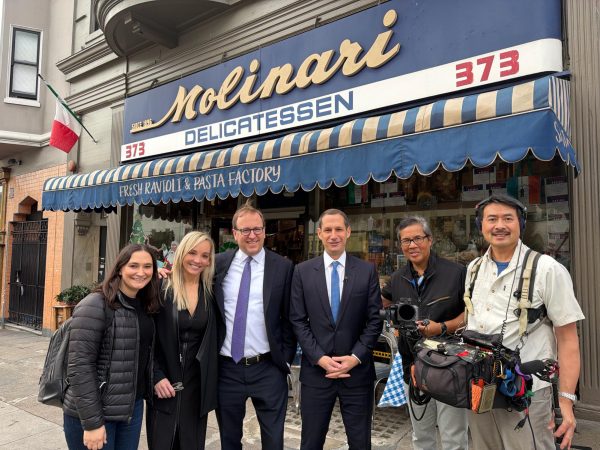
In May 2020, during the peak of the COVID-19 pandemic, Cherner graduated from USC but struggled to find a job in the first few months. After getting connected to the hiring manager for the ABC News’ Washington, D.C. bureau, Cherner was hired as a desk assistant in October 2020.
“All the networks have rotational entry-level programs, where you rotate around the newsroom. I was doing teleprompting and overnights and very unglamorous jobs at all hours, but it was a really great experience,” Cherner said. “ I rotated onto the Sunday show as part of the program, and I ended up getting hired as an associate producer and was then promoted to segment producer. Now I am a producer for the show where I primarily work with Martha Raddatz, one of the co-anchors.”
A career in journalism offers opportunities that many other professions do not, largely because no two days look the same. For Cherner, that unpredictability is part of what keeps the work engaging.
“There’s no typical day, which I really like. We air weekly, and we primarily cover politics, but also breaking news, so we’ll book politicians, senators and world leaders, and interview them about the day’s events. I’ll either be assigned to [prepare] the anchor for those interviews, or I’ll be assigned a story where I’ll travel with the anchor,” Cherner said.
Through traveling with the anchor, Cherner has gained firsthand experience covering international politics and conflicts while strengthening her reporting and production skills.
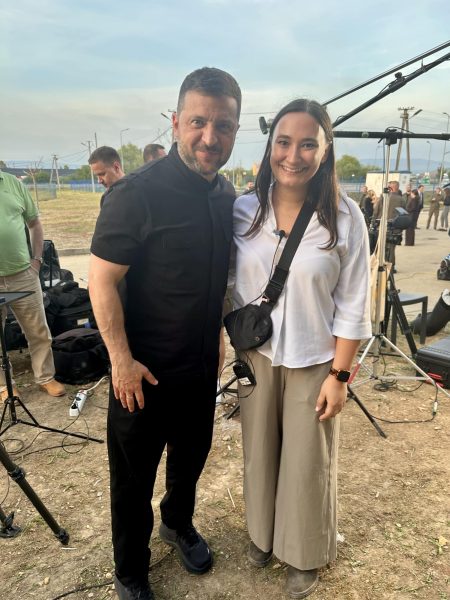
“This past September, I went to Ukraine with our anchor, Martha Raddatz, and produced an interview with President [Volodymyr] Zelenskyy,” Cherner said. “That was definitely the most memorable thing that I’ve ever done in my professional career,” Cherner said.
Reporting on important global issues such as the war in Ukraine not only informs people about current events, but it also shows the impact journalism can have on affected communities.
“The Ukrainians were very thankful to us that we were covering the war, and it showed me the impact of news and media and how important it is that journalists cover these stories even though they’re hard to get to and expensive, because they can have such an impact,” Cherner said.
Earlier this year, Cherner and the team she worked with were nominated for an Emmy for the production they created in Ukraine.
“It was really exciting. I was nominated for the Zelenskyy interview, and I’d been nominated before, but not for something that I so directly worked on. I feel really fortunate to be able to go to so many different places and tell important stories because I think there’s always a need to tell stories, especially through video. It’s never going to go away,” Cherner said.
With the importance of covering global politics comes the challenge of maintaining objective and balanced reporting. For instance, many publications across the U.S. are perceived to be biased toward a particular political party because of their coverage selection and wording. For Cherner, integrity and factual reporting are the most important parts of her work.
“My job is for people to understand what’s happening and what the facts are so that they can form their own opinions. How I feel about something is irrelevant. Everyone at ABC [News] is so motivated by the need to have unbiased news, especially right now, because it’s such a polarizing time. I don’t even know what my co-workers’ political views are because we don’t talk about them. The work is what’s more important,” Cherner said.
Cherner’s success in the world of journalism took time and patience, and she emphasized the importance of staying persistent because of how fulfilling her career has been.
“I would really encourage students to pursue [journalism]. It’s such a valuable and rewarding career. I get to learn new things for my job every week and I get to talk to the smartest people on those topics,” Cherner said. “Don’t let rejection stop you. I was rejected for jobs and schools on the way, and I feel like rejection should be used to fuel you and your next steps.”