As students, we are told that school prepares us for the future, yet many of the assignments we complete never translate to skills we can apply outside the classroom. We study for hours, retain everything before a test and then a week later, that information is forgotten. This pattern of short-term memorization is reinforced by the typical school day, that doesn’t involve hands-on work unless it’s to take notes or complete busy-work.
When I think about meaningful and productive learning that I have had in the past, I think back to middle school, when I built a 3D sculpture of the Hanging Gardens of Babylon from all recycled materials. Two of my classmates and I spent weeks planning, designing and adding our own creative additions to the building. Through this project I understood the true significance of this piece of history, while also looking forward to coming into class each day.
However, when thinking back to the past few months, I can’t recall the last time I engaged in a project that taught me something in the same depth that project did during those few weeks.
Most of the time, in-class work just feels like something to keep students busy. Besides the occasional lab, much of our class work feels surface level, making it difficult to connect with the material.
Many of our core classes, specifically math, science and history curriculums all follow the same pattern. Students take notes, memorize concepts and crank out tests as best they can. During class hours, students tend to lose focus easily because the day can feel very repetitive and often unengaging.
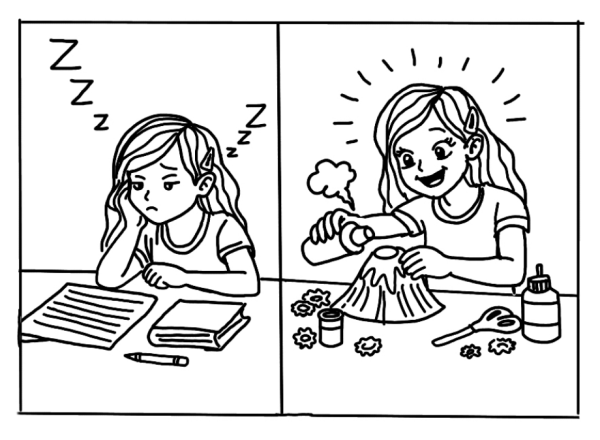
Our class curriculum should stop repeating this routine, and start to teach concepts in a way that will actually stick. Why are we held to such high expectations on tests when the way we learn doesn’t prepare us to think deeply? Being able to perform under strict time limits shouldn’t be the main measure of our knowledge.
By replacing some traditional assignments with hands-on projects, learning could start to feel more meaningful. A study done by the George Lucas Educational Foundation during the 2016-17 school year revealed that high school AP students using project-based learning were 30% more likely to pass their AP exams.
Therefore, not only would students be more engaged during class, but they would also have a higher likelihood of passing their AP exams.
In a world full of technology and artificial intelligence that takes credit for a lot of student learning, good grades and deep understanding of concepts should be coming in a variety of different ways. Taking time to process information through hands-on projects allows students to take ownership of their learning. The process of working towards something challenging but attainable can teach problem solving skills, perseverance and creativity.
This isn’t just about trying to catch the attention span of easily distracted teenagers, it’s about listening to how many students’ brains are wired.
In a Carson-Newman University study, from 2024, researchers found that learning becomes more permanent when students actively apply information instead of just hearing it. Students who participated in more dynamic, collaborative learning outperformed those in traditional lecture-based classrooms, with 54% higher test scores.
According to research highlighted by the JUMP! Foundation, a report made in 2002 about experimental learning statistics, the data directly supports hands-on education. The way that students remember information changes. Students retain up to 90% of what they learned through active hands-on learning, compared to just 5% of information through typical lecturing.
Active hands-on classrooms don’t just improve understanding, they change how students feel about school altogether. When students are given the opportunity to collaborate with classmates and be creative, the act of learning would feel less like a chore. The sense of purpose naturally increases motivation, because students would be able to see the value in their work.
In the real world, no one hands you a worksheet and tells you to solve problems neatly on a paper without error. So why is this still the main way we learn in school?