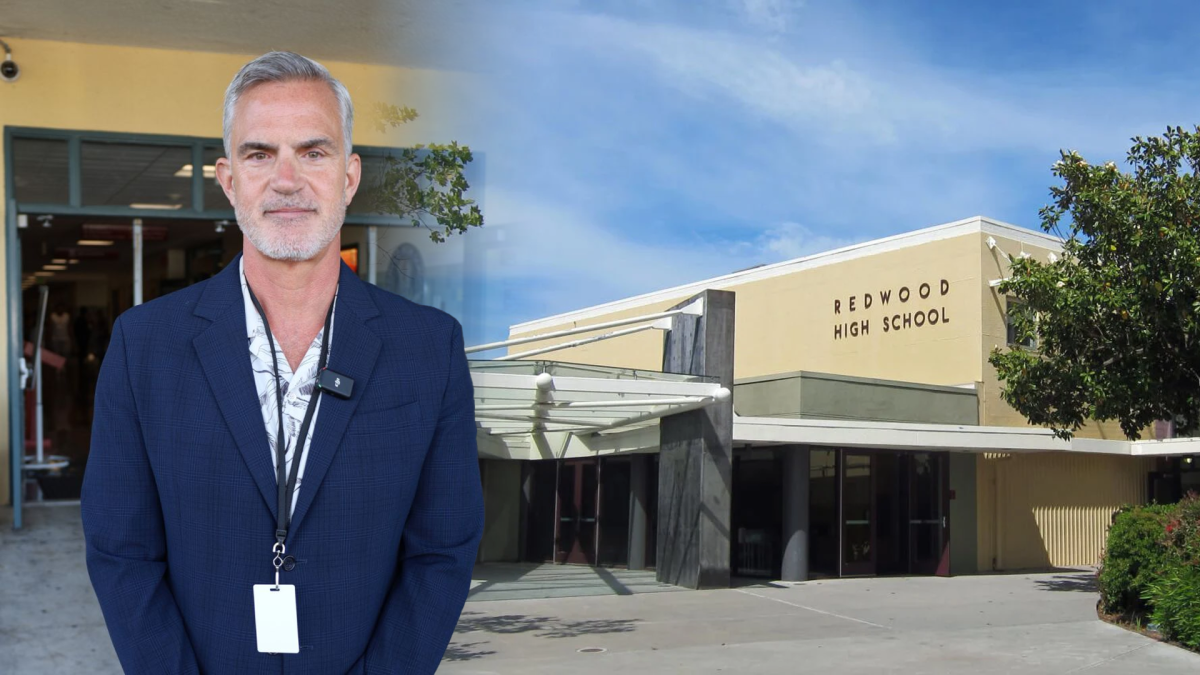
Families were updated about community-wide concerns regarding course schedules for the upcoming 2026-27 school year on May 29 in an email from the Redwood High School administration via StudentSquare.
“This year, our administration team, working with the district office, has informed us that we can guarantee students have at least five classes, and many elective courses are full. This includes upper-division electives in English, science, social studies, math and art. Students who requested two math or English courses may receive one, and students who requested more than two science courses may not receive a third,” Counseling Secretary Simone Davis said in an email.
The email came in response to a number of students being deferred or denied their requested courses for the upcoming school year. According to Redwood High School Principal Dr. Barnaby Payne, who manages the master schedule for students, the district is no longer allowing students to “double up” on certain elective courses such as Advanced Placement (AP) Language and Composition and AP Seminar starting next year.
“What happened with AP [Language and Composition] and AP Seminar is that before we made this change, AP Language [and Composition] had 35-36 students per class, and AP Seminar had 25 students per class,” Payne said. “So we made the decision to close a section of AP Seminar and open another section of AP Language [and Composition], so now the class sizes are [more] balanced.”
The reductions in certain courses are a product of diminishing enrollment and fewer full-time equivalent (FTE) educators in order to conform to budgetary projections and the decreasing student population. Payne explained the allocations of FTEs at Redwood High School to explain why certain nonrequired courses are being downsized.
“We have about 90 FTE at Redwood, 10 of those are committed to special education, 80 are committed to general education. Of that 80, 60 are committed to the required [Tamalpais Union High School District (TUHSD)] requirements [and] University of California required and recommended coursework,” Payne said. “About 20 percent to 25 percent of our staffing is committed fully to electives only, beyond the University of California’s required and recommended coursework, which also includes the [TUHSD] graduation requirements.”
When cutbacks to staffing are needed, the district first looks to cut down extracurriculars that aren’t necessary for University of California requirements or graduation requirements. Reductions across the district’s sites have been heavily cited as a result of budgetary concerns and declining enrollment. According to the TUHSD second interim budget report, the district cited declining student enrollment as the No. 1 fiscal challenge for school districts for the next 20 years. School district annual costs are also growing at a rate greater than 5.5 percent, while income is slowing because of projected stagnant revenue resulting from flattening property tax revenue growth and the expiration of Proposition 30, which will be on the November 2026 ballot.
The district receives approximately 80 percent of its revenue ($90,897,761) from property taxes for its unrestricted budget, according to the second interim budget report. The unrestricted budget is the district’s non-discretionary fund for general education that the district uses to finance courses across the three sites and alternative education schools. TUHSD Chief Financial Officer Corbett Elsen explained that property taxes are the driving factor in budget reductions across the district.
“Property tax revenue has dropped from our historic average of about five percent. We’re dropping it to 3.8 percent. That’s relative; that’s well over a million and a half dollars of loss of revenue per year,” Elsen said. “On the flip side, expenditures statewide are growing 5.75 percent. A two percent difference on a $140 million budget is about $2 million each year that grows unless we adjust.”
Property tax revenue has consequently stagnated as a result of lagging growth in housing demand in Marin County and the effect of California’s Proposition 13 measure. TUHSD Board Trustee Kevin Saavedra described the effect of Proposition 13 on property taxes and district revenue and how the lower-demand market hinders revenue growth for the district.
“Property taxes go up two percent a year, every year, except if someone sells,” Saavedra said. “By [Proposition] 13, someone could have bought their house 30 years ago for [$500,000], and its current value is three and a half million dollars. The value of that house, pursuant to the taxable value, would be $500,000 plus two percent a year over 25 years. Call it $750,000. But the market value can be $3 [million] to $3.5 million. So if that house sells, the property tax will be one percent of $3.5 million, but alternatively, the property tax will end up one percent of $750,000.”
The district has seen numerous reductions to courses across the three main campuses of Tamalpais High, Archie Williams and Redwood as a result of this revenue slump, including reductions to the outdoor education program TEAM at Archie Williams, which was reduced to a one-year program for budgetary reasons. More notably, the district underwent a significant reduction to the alternative education campuses of San Andreas and Tamiscal, which will be consolidated onto one campus with reduced staffing, saving the district more than $2.2 million.
The staff reductions are key for the district to remain fiscally solvent. According to the 2025-26 second interim budget report, the district spends a combined total of approximately $96,873,969 on staffing. That spending pays for certificated staff salaries, classified salaries and staff benefits. Spending on staffing represents around 75 percent of the total fund budget for the 2025-26 school year. Elsen dubbed the staff reductions as district “right-sizing.”
“The reason why … we’ve been right-sizing or reducing staffing each year [is that] we’ve had declining enrollment at each school. That’s been happening the past six years. Every year we’ve been going downhill in enrollment, every year we reduce the number of teachers because we don’t have as many students who need them,” Elsen said. “We had to reduce more this upcoming year because our revenues dropped because of the property tax revenue drop, so we had to balance our budget by making further reductions, primarily at the alternative schools and also having to tighten our staffing a little bit further at all the schools.”
Reductions are important to the district in order to maintain what Saavedra described as a financial “cushion” in the district’s reserve.
“We’re trying to rationalize our operations in light of lower revenue without having to dip into our reserves because our board is committed to keeping our reserve at 17 percent of our budget,” Saavedra said.
The financial cushion comes as the district has noted a plethora of concerns in its revenue projections, concerns that could lead to lower-than-expected revenue. Elsen mentioned rising costs due to the war in Iran and fears of an Artificial Intelligence bubble that could affect the housing market in a significantly impactful way.
“A lot of people who live here work in Silicon Valley, directly or indirectly, in financial services and technology. And if the bubble pops, there are people here that may not be able to afford to live in our community at the high value; they may have to sell it at lower values,” Elsen said. “If people aren’t buying homes, there’s less sales, the prices are going lower, interest rates go up with inflation — all that combined depresses the property tax revenue we get.”
Elsen said the 17 percent reserve is for “any uncertainty unknown.” Although there is no way to predict certain economic uncertainties, the district has worked to maintain its “rainy day” fund for emergency preparedness.
“There’s a lot of uncertainty in this world, and my job is to make sure we have sustainable programming for today’s kids, tomorrow’s kids and five years from now, because all of our kids deserve what the graduates have had for the past couple decades,” Elsen said.
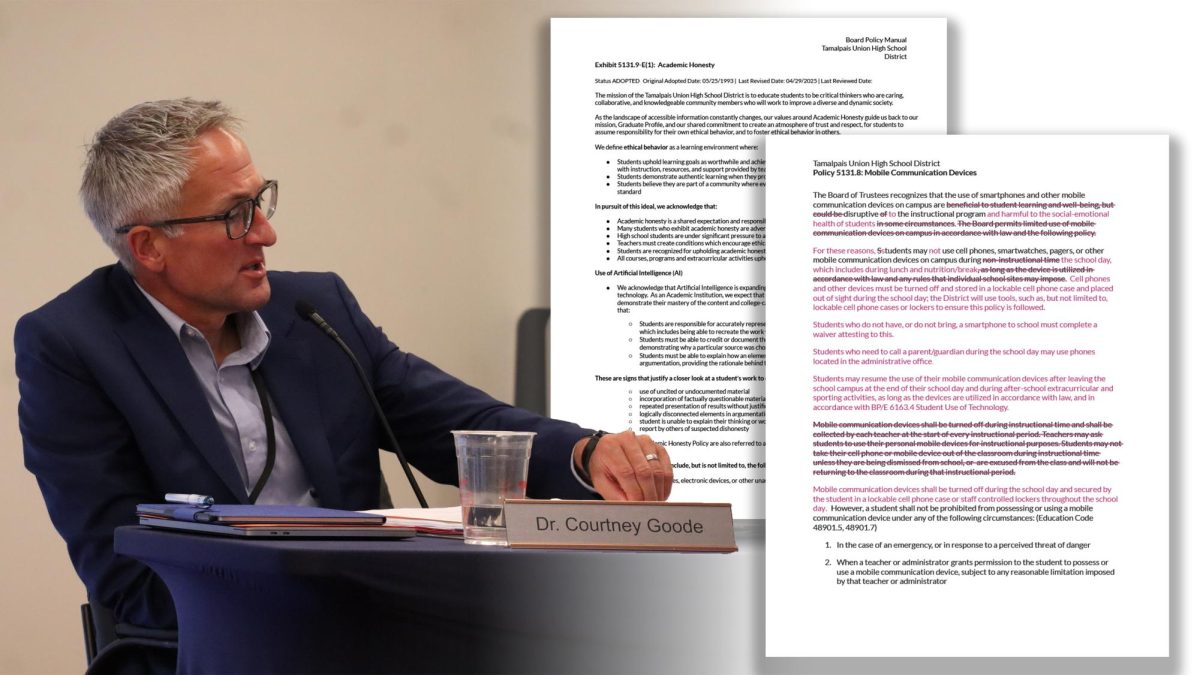
![Assistant Superintendent of Business and Operations Corbett Elsen presented an updated budget proposal for the 2026-27 fiscal year to the Tamalpais Union High School District (TUHSD) board of trustees on Tuesday, June 16.
Elsen presented an in-depth analysis of the district’s revenues, expenditures, future outlooks and the global and economic uncertainties affecting the district's revenue due to inflation and the war in Iran.
Because TUHSD is a basic-aid district, Elsen explained the significance of the housing market, stressing the gravity of the district’s financial situation as a result of lower demand.
“This is the bread and butter of our revenue: property tax revenues, [projected] to bring in over $93 million,” Elsen said, adding, “But ... we have decreased our revenue growth rate [projections].”
Elsen will return to the board of trustees on June 23, where the board will take formal action to adopt the proposed budget. To learn more about the updated budget proposal from the meeting, visit the June 16 TUHSD Gamut Online agenda.](https://redwoodbark.org/wp-content/uploads/2026/06/snapshot-1200x675.png)