
As we seniors approach the end of the school year, questions like “Have you found a roommate?” or “I DMed 14 potential roommates before this” echo through conversations and social media feeds. At Redwood alone, 46 percent of students are planning to room with someone they met online (May 2026 Bark survey).
So, instead of spending time studying for Advanced Placement (AP) exams or attending Saturday school to make up for absences, most seniors have been playing a long game of 20 questions with prospective roommates via Instagram Direct Messages (DMs). We spend hours scrolling through curated profiles, searching for someone with the same aesthetic and questioning potential roommates about their music taste, sleep schedules and lifestyles as if reviewing a resume. According to the same Bark survey, 30 percent of students find searching for a roommate to be stressful to very stressful, while only 17 percent find it very exciting.
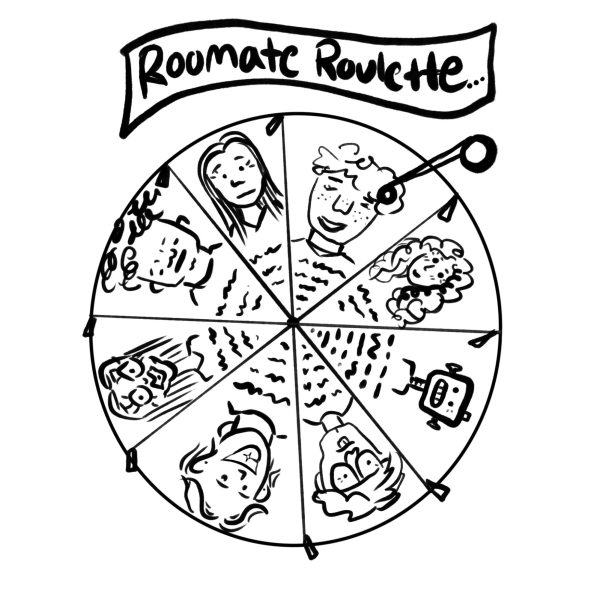
The pressure to secure the “perfect roommate” has become a defining part of the transition from high school to college, making people forget that there is an alternative option: random roommates.
By definition, a random roommate is someone whom the university housing department assigns to students. No DMing, 2030 Meet Accounts or mass messaging needed. Some universities have already implemented a random roommate requirement, such as Duke, Dartmouth, New York University, Brown, Wake Forest, the University of San Diego and many more.
For many seniors, going into college with the comfort of a chosen roommate is reassuring. As freshmen navigate their new campus, city and social scene, going back to their dorm with the security of a “built-in best friend” is a pleasant thought.
However, a big part of the college experience is facing the unknown and putting oneself in uncomfortable situations. Having a randomly assigned roommate offers this discomfort, along with other valuable life lessons. It teaches self-awareness and respect, promotes personal growth and opens students up to diverse experiences.
According to Julie Lythcott-Haims, the author of “Your Turn: How to Be an Adult” and a former dean of first-year students at Stanford, “College is meant to be a time of life when you step out of your comfort zone, and you’re stretched. If people are allowed to choose their own roommates, they’re inherently cutting themselves off from some of the most significant learning available, which is to grow up your freshman year with someone not like you.”
As Lythcott-Haims puts it, living with someone who is unlike oneself allows them to develop skills such as adaptation, compromise and communication. Random roommates teach students flexibility, as they navigate living with someone on a different wavelength. In addition, students don’t face the social pressure to follow their friends’ schedules, allowing for greater independence and a smoother transition into adulthood.
University of Wisconsin-Madison student Lillie Sunby wrote about her experience living with a random roommate, explaining how it taught her valuable lessons about respect and adaptability.
“I didn’t know learning to coexist with someone was one of the most enriching experiences of my freshman year. You don’t need to love your roommate. You just need to communicate effectively and respect each other’s boundaries.[/pullquote]We developed a mutual understanding of each other’s needs, whether it was leaving the lights on low so my roommate wouldn’t struggle to get ready for bed at 3 a.m. or knowing to leave the room if I was working on a project late at night so my frantic typing wouldn’t disturb her,” Sunby said.
In addition to the personal growth brought by random roommates, randomness can also expose students to diverse backgrounds and perspectives that don’t normally fit into their own social circle. This was one of the driving factors in Duke’s decision to require random roommates. Dr. Sarah Gaither of Duke’s Psychology & Neuroscience Department explains the psychological justification behind the university’s choice.
“Intergroup Contact Theory in psychology research argues that long-term meaningful exposure to someone who is different [from you] can reduce anxiety when meeting someone new for the first time,” Gaither said.
Gaither also explains that students with random roommates often have more open and honest conversations across racial groups and greater diversity within their friend networks.
For Duke freshman Ishika Gupta, being randomly assigned a roommate was an opportunity to meet someone new.
“One of the reasons why I loved [going random] is that my roommate was an engineering student, so there was no reason for us to ever meet at Duke except because of the random policy. I feel that because of it, I got to meet her,” said Gupta, a pre-med student at the time.
Experiences like this highlight how random roommates can offer more diversity within social circles, giving students more exposure to backgrounds, lifestyles and perspectives.
Besides the learning experience associated with random roommates, it can also lead to more successful room dynamics and stronger relationships. When comparing satisfaction rates among adults with a roommate, strangers outperform acquaintances. While having a stranger as a roommate comes in at 24.7 percent satisfaction, an acquaintance only rates at 23.4 percent (Apartmentguide.com).
Another way to think about it is taking a class outside of one’s major. It may feel uncomfortable during the first few lessons, but it offers a student knowledge, skills and a potential new interest. The same applies to a random roommate: it begins awkwardly but has the potential to bloom into a valuable friendship.
Still, some people advocate for choosing a familiar roommate. Articles like Isabella Cabrera’s “From friends to roommates: 4 benefits and 4 tips for living with people you know” argue the benefits of living with someone you know, such as offering comfort and company in a scary time period. Especially because going random offers the risk of getting someone who doesn’t fit your lifestyle. And it’s true: living with a stranger, regardless of compatibility, isn’t comfortable, and can make the transition more difficult; but that is why it’s valuable. Much of the value of a random roommate is learning skills like setting boundaries, communicating and navigating awkwardness.
Additionally, rooming with a high school friend can strain a pre-existing friendship through living-related arguments, making the friendship worse off. It can also close students off from new social circles that come with randomness.
For me personally, the university I will be attending next fall is one of the few that require random roommates. What started as a potential con to me soon transformed into something I’m excited for. The more I debated the pros and cons of going random, the more I saw the positives behind the experience it offers. Firstly, going in with a random roommate removed the stress of roommate hunting. It will also open my college experience up to more people. If my roommate were my best friend, I would find myself with them constantly. Instead, I’ll have opportunities for discomfort, offering a chance to break out of my comfort zone.
Overall, there is so much value in the roommate selection being random. Not only does it get seniors out of the awkward social media flirting stage, but it also exposes students to valuable learning experiences. So when your next roommate prospect exhibits a red flag, or you feel like you can’t ask another person what their major is, consider going random.