
“It used to be [that] if you see a windowless white van, and a man is asking to give you candy, run the opposite direction. Well, the windowless white van analogy is now just online,” Supervising District Attorney Investigator of the Marin County District Attorney’s Office, Andre Longtin-Horton said.
How are children in danger?
Child exploitation online can seem like a distant issue, one that everyone fears. In reality, few people know how to detect predators online and protect their children from individuals who can cause immense harm to their loved ones. Longtin-Horton works with the Internet Crimes Against Children Taskforce (ICAC).
“ICAC is a nationwide effort to combat online child exploitation. There are 61 coordinated task forces throughout the United States,” said Longtin-Horton.
One of ICAC’s main goals is to inform parents and children on how to protect themselves online. In addition, ICAC investigates cases of crimes against children that include child pornography and other Artificial Intelligence (AI) generated material of children. Sextortion is one of many examples of other AI-generated material. According to the Oxford language, sextortion is “the practice of extorting money or sexual favors from someone by threatening to reveal evidence of their sexual activity.” Sextortion is a common issue in cases that come through ICAC.
Longtin-Horton noted that the National Center for Missing and Exploited Children (NCMEC) operates a 24-hour cyber tip line and that most of the cases the ICAC handles come from NCMEC.
“We’ll get a cybertip report saying that one child was approached on Instagram or Snapchat and sextorted that way. Another way that we get these tips is through kids reporting it to their parents, and then their parents reporting it to the police,” said Longtin-Horton.
Longtin-Horton explains that blackmail is often involved in cases of sextortion.
“We’ll get calls [from] people saying that they think their child might be a victim of sextortion — then it gets investigated, and it turns out that somebody messaged them on Snapchat or Instagram and said, ‘I have photos of you, and please send me X amount of money. If you don’t, then I’m going to release this to your family,’” Longtin-Horton said.
Longtin-Horton describes the variable process of investigating these cases.
“A lot of these cases are overseas, so there will be a perpetrator out of another country, [or perhaps] across the world. In that case, a lot of times we send it to the federal government to investigate federal law enforcement, whether its Homeland Security Investigations (HSI), to the Federal Bureau of Investigation (FBI), any one of those. [We] will send them off to them, and they sometimes investigate those cases. If it’s local, we’ll kind of go down the rabbit hole of investigating here and hopefully be able to arrest the suspect,” Longtin-Horton said.
Longtin-Horton describes how a common scenario of sextortion is that a perpetrator pretends they are a juvenile and talks to the victim enough until the victim feels comfortable sending a promiscuous picture of any kind, and then blackmails them for money.
Another common scenario is that the perpetrator will assume that a teenager has sent a sexual picture at some point in their life. They will then search for hints from their social media platforms, such as Instagram or TikTok, for more details. They might try to find information on where they live, where they might shop or where they go to school. With any information the perpetrator gathers, they will use it to make the victim feel as if they recognize them, and that maybe they saw them somewhere. Then, when the perpetrator brings up having the image, the victim is more likely to believe that maybe the perpetrator could have this picture, and sends money to avoid the picture being exposed to their family or friends.
Before Longtin-Horton was at the district attorney’s office, he was at the Marin County sheriff’s office for about eight and a half years. He estimates there are about one to two cases a month of sextortion within Marin County, showing an increase in these cases.
“There’s an increase just in that there’s a higher level of participation online, and there’s always new platforms. [For example,] Discord and Roblox and [other applications] have really exploded, and with that comes a lot of opportunity for sextortion and online exploitation in general,” Longtin-Horton said.
Heather White, a detective in the investigators division for Marin County, explains why sextortion is underreported in some cases.
“I think sextortion is probably underreported just because of the embarrassment factor, which is really unfortunate, because these cases can lead to teen suicide. The grooming is escalating, and now there are several different types of grooming, which unfortunately, can lead to sadistic online exploitation and suicide,” White said.
Marlene Capra, who created the task force “speaksafe.org,” which aims to bring awareness and support to youth exploitation, believes that sextortion cases in Marin County are less highlighted because of how Marin County schools view the issue.
“Here in Marin County, they [thought it was] okay to have topics of substance abuse. It was okay eventually to have it on the topic of mental wellness, but it was not okay to have it on the topic of exploitation. They definitely did not want the words ‘human trafficking’ used in our county, because they didn’t want that stigma attached to any of our schools. Unfortunately, it happens in every zip code,” Capra said.

(Marlene Capra)
How minors can protect themselves
When a child is at risk of sexual exploitation, the child must understand the tools available to notice red flags and what to do when they feel like they are in an unsafe situation.
When a child has an online presence, especially if their account is public, their information is online for the world to see and interpret however they choose to. White highlights the importance of smart online usage.
“All of the information that [a child] puts out there allows somebody to then use that information to try to prove they know them when [one is] posting pictures at school, at sporting events with ones travel teams, pictures on vacation, and one is tagging all of their family members, the more somebody knows about that person,” White said. “Then children are more likely to be inclined to talk to that person, because one may think that they actually know the perpetrator, when, in reality, one may have just put all of that out on the internet for them, which is accessible to anyone.”
Longtin-Horton emphasizes that the first major red flag is how a predator acts online with the victim.
“I think the biggest tell is a constant desire to please on the part of the offender. So the suspect is going to basically give this person whatever they want and make them feel amazing without any negative [consequences]. Everyone knows that’s just not how conversations go. If you’re engaged in a conversation with somebody, and it just seems like it’s too good to be true, it probably is too good to be true,” Longtin-Horton said.
In most cases, a predator finds access to their victim online. This may be when a person online is asking you a lot of information about yourself, but won’t disclose any concrete information about themselves. Longtin-Horton notes that children and teenagers must do their due diligence when they are using social media and revealing any information.
“You’re on Snapchat, and you see little Johnny is friends with you, and little Johnny is a mutual friend of your best friend. All you have to do is reach out to your best friend, say, ‘Hey, who is this little Johnny?’ And if they say, ‘Oh, I don’t know. It’s just somebody I added,’ [then that person is] probably [someone] you don’t want to add,” Longtin-Horton said.
Horton continues to add how, although social media can be a place where people want to have more followers and friends, sometimes it is better not to have as many followers if it means you are vetting the profiles of people who have access to your information. White provides crucial information on what to do as soon as an individual thinks they are the target of online exploitation.
“Immediately, you want to stop responding. Take screenshots of the conversation. If it’s happening over Snapchat, I know that it notifies the other user, [so use] a secondary device to take photos, then you can report the user and block them immediately. Then, tell a trusted adult. Do not send any more images, don’t pay any money, don’t respond to their demands and don’t continue the conversation,” White said.
Some victims are faced with the hard situation of having leaked images of them on the internet. Most feel like they can’t do anything about this. White mentions how to solve this issue once the pictures are already released to the internet.
“If you are a victim of sextortion, you can contact takeitdown.org. Follow their process, and they will help get that picture off the internet. There are also other online resources through NCMEC, as far as how to get help,” White said.
How parents can help their children
When a child is in a dangerous situation where an online predator is contacting them in an attempt to receive something from them, whether it be money or child pornography material, the child needs support in many ways, and one of those ways is through a parental figure.
One mistake a parent can make is assuming their child is safe from the dangers that come with being online. Longtin-Horton describes that online exploitation doesn’t have any bounds.
“We get a lot of affluent kids who are victims. I think people would tend to think that affluent kids have access to the highest level of everything they could want, and it steers [predators] away from them. But what is really apparent from my time doing this is that [sextortion] does not know any socioeconomic bounds. You really have kids from all different walks of life that are getting involved in this and are affected,” Longtin-Horton said.
Longtin-Horton adds that in terms of gender of targets, there is no even split between females and males; he believes that both genders fall victim to sextortion. Furthermore, he states that the ages of victims are becoming younger and younger, and emphasizes the importance of parents discussing these issues with their children earlier. Longtin-Horton believes that victims’ ages range from as early as eight to 18. Although he says 18-year-olds are a bit more assertive, they can still be victims.
Longtin-Horton emphasizes the importance of parents having early conversations with their children, so if the issue arises later in the child’s life, they feel comfortable talking to their parents about it.
“I always say having the conversation early and often is best. The earlier that parents have this conversation, the better. If you’re going to give your kid a phone in middle school, have this conversation at fifth grade. Have an age-appropriate conversation about the dangers of exposing yourself to everything online and everybody that’s online,” Longtin-Horton said.
Longtin-Horton also describes some red flags in a child’s behavior that parents should watch out for and that could reveal if the child is being exploited online.
“[Parents should] look for changes in behavior, whether it’s needing money or hiding things. Also, trying to break [phone] guidelines and take their phone back when they shouldn’t, little things like that,” Longtin-Horton said.
It can be very tricky for a parent to know how to monitor their child and protect them when the time comes without violating their child’s privacy. Longtin-Horton describes how, sometimes, a parent should ignore the emotional aspect and prioritize safety.
“A parent has a job: keep [their child] safe. Sometimes that may not be in alignment with everything that the child wants, in terms of unfettered access to every social media app that the friend has, but as a parent, that’s the hard decision you have to make. The number one job for you as a parent is to be a parent. Your second job as a parent is to be their friend,” Longtin-Horton said. “Being a parent and really making sure that you set these guidelines and boundaries early is really important. I found that when parents do that and create clear expectations from the start. They save themselves a lot of headaches on the back end.”
Longtin-Horton also observes that most parents want to be their children’s friend too much and less of a parent figure and notes how this can result in their child being at risk.
“[Parents] want to be their kids’ friend. I know that in Marin, a lot of parents want to be their kids’ best friend first, and parents second. Break that cycle and realize that you need to be a parent when it comes to this stuff, because it can actually have life or life or death implications, and realizing that it would be better to have your kids be mad at you for a couple of days,” Longtin-Horton said.
The dangers of online child exploitation can be extreme. Longtin-Horton explains how the risks online are exposing children to more mental health struggles, and an increase in suicides and self-harm.
Parents having honest and open conversations related to the dangers online can help their child feel more comfortable talking to their parents if an incident does occur online. Capra highlights the need for parents to create a comfortable environment for their children to discuss topics like these.
“The role [parents] should play is having conversations saying, ‘You know what, if something happens, you’re not going to get in trouble.’ Parents need to let their children know that if something happens, they will be there for their children no matter what, and they have to really mean it and have ongoing conversations,” Capra said.
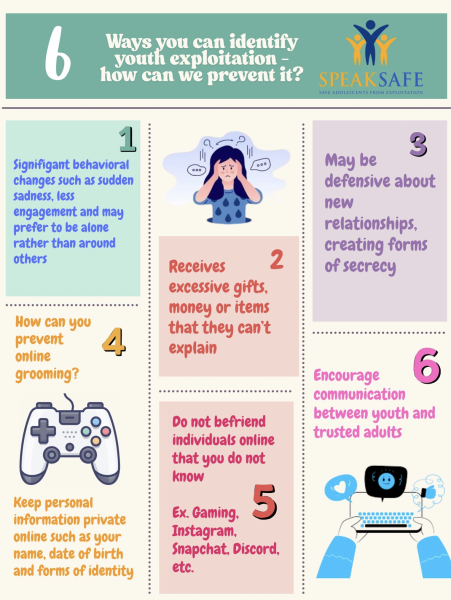
Help available for exploited teens or worried parents
Capra’s experience in the field of protecting children and youth from exploitation makes her a prominent figure in the fight against child exploitation. Capra highlights why she created the taskforce speaksafe.org, and ways their initiative will help several children and educators.
“We saw an increase in our youth being exploited in our own county, youth being exploited and trafficked. As someone who has personally experienced exploitation and was in school at the time, I can tell you that educators really aren’t aware of the signs of when someone’s exploited: how to help and support them, how to pick up on that, what even what resources there are,” Capra said.
The issue with online child extortion is that most children don’t even know they are a victim. “So many [child exploitation devices] are compromising our young people in such a way that is not talked about. [Children] don’t even understand they are being victimized,” Capra said.
Although the issue of child exploitation can feel like a distant issue, Capra discusses how this issue exists much closer to home than people assume.
“If you’re someone who is not being exploited, that’s great. But guess what? You know someone who is,” Capra said.
Although the issue of child exploitation is scary, there are numerous resources available to children, teens, parents and educators to combat this issue.
Speaksafe works with a team of high school juniors and seniors in Marin County to efficiently reach their peers and to help spread awareness and information. Speaksafe training is also available for those who would like to become better educated to detect predators online, how to avoid them and what to do if you are a victim.
Ending online child exploitation will require more than awareness; it will require action. Tech companies, parents, law enforcement and individuals must all play their roles in protecting children in this digital world. By staying informed with programs like Speaksafe, we can be the solution. Change is happening, and with continuous effort, Speaksafe will enforce a safer world.
For access to training, support and all things child exploitation awareness, resources are linked below.
https://www.speaksafe.org/new-page
https://www.missingkids.org/home