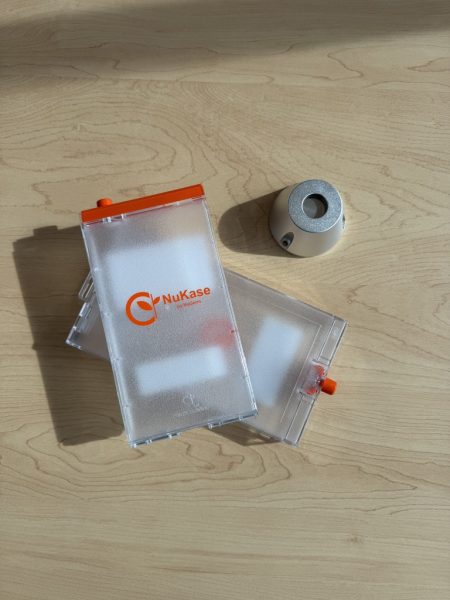
On Tuesday, April 14, the Tamalpais Union High School District (TUHSD) board voted 3-2 in favor of implementing a revamped phone-free schools policy for the 2026-2027 school year. Starting in August, all three comprehensive school sites within the TUHSD will use NuKase lockable phone cases, and alternative education sites will implement storage lockers to manage student devices during the school day. The decision came after months of research, feedback and a board meeting on March 24 that drew over 18 public comments. This new policy will be enforced bell-to-bell: from the moment a student steps onto campus until the final bell rings at the end of the day. This vote marks the district’s largest step so far in addressing what administrators have recognized as a growing mental health and learning crisis, driven by smartphone addiction.

Superintendent Dr. Courtney Goode spearheaded the creation of the new phone policy and led a TUHSD board discussion on March 24 considering implementation. The discussion originally described the implementation of Yondr pouches, a previously considered phone-locking mechanism, diving into a cost breakdown that assumed around a $145,000 cost for the first year and a $30,000 ongoing annual fee afterwards.
“They’re not free, I recognize that. There’s a cost of not doing anything, too,” Goode said.
The cost of Yondr pouches alarmed students and community members, according to Redwood Student Board Representative Adriella Marcus. Marcus stated at the March 24 discussion that she’d received concerns from fellow students about where the funds would come from and what Yondr implementation might take money away from as a result. Goode addressed that concern during the April 14 board meeting and offered NuKase as a new, budget-cautious option.
The implementation of NuKase technology costs the district $104,000 with an ongoing annual fee of up to $10,000. The one-time cost of NuKase is about $41,000 less than that of Yondr. Goode also detailed that the ongoing cost only requires up to 0.0007 percent of the TUHSD’s annual budget.
Goode has been clear that the push for NuKase and a phone-free school policy is not a condemnation of the district’s existing phone caddy system. In fact, Goode believes it works for the majority of students during instructional time, with only occasional gaps in enforcement. The real concern is what happens outside of class time, during the ten-minute passing periods, lunch breaks and all other moments between learning. Administrators believe smartphones pose a major threat to student wellbeing, social development and educational growth.
“Cell phones and social media are addictive, harm mental health and impair learning. If we know something that our kids have is addictive, harms their mental health and impairs their learning, why are we allowing it? What if we said, ‘Turn in your flask of vodka by the teacher’s desk and then do what you want in between classes.’?” Goode said. “When you grab your cell phone after class is over, you’re no longer in waking consolidation. The [breaks within the] cell phone jail [system] contribute up to 11 hours of lost instructional time per week. That’s 56 days less of school learning in a year.”
Goode’s perspective is rooted in research that he has made a central piece of the district’s decision-making process. He has repeatedly pointed to Jonathan Haidt’s “The Anxious Generation” and Dr. Jared Cooney Horvah’s “The Digital Delusion,” particularly the chapter “Smartphones: A Special Kind of Bad,” for evidence that supports the push for a phone-free school environment. Goode encouraged the community to read both books, and some board members did so before casting their votes on the new policy on April 14. Board member Emily Uhlhorn emphasized that students should be educated on the topics covered in the novel to help better understand and accept the rationale behind the new policy.
Goode said he has also taken inspiration for the new phone-free schools policy from neighboring school districts.
“We don’t need to reinvent the wheel. It’s proven successful elsewhere, I don’t see any reason why it can’t be successful here,” Goode said. “At the schools that have implemented it, one of the principals said, ‘I can go an entire week and see one or two phones only.’”
Not all teachers have the same faith in the effectiveness of this new policy. Math teacher Jason Adams said that though phones are an issue on campus, he’s unsure whether TUHSD’s new policy is the correct initiative to be taken.
“It’s a very big problem, and the [NuKase lockable phone cases] are a bad solution to a very important issue,” Adams said. “But, addressing it in a bad way is better than not addressing it.”
On a similar note, junior Soren Smith said that while he understands the district’s intentions, he isn’t sold on the intended solution.
“I believe their intention is definitely in the right place and there’s 100 percent some truth to problems with kids being glued to their phones,” Smith said. “But, me and a lot of my peers just aren’t sure if this is the exact right approach to fixing the issue.”
In general, students appear to take the same stance on a stricter phone-free schools policy. A March Bark survey reported that 86 percent of surveyed students opposed the implementation of lockable phone cases.

Adams also questioned how the actual implementation of the cases will work, stating he wishes further steps were taken to adjust the current policy before jumping into a new, stricter one.
“It would be nice if the current rules were enforced before they changed or abandoned the rules,” Adams said. “I disagree that a teacher that wasn’t following the current rules would start following the new rules more, unless there was an added consequence or incentive. Managing the new policy, on top of the already many parts of my job, seems like a lot.”
Goode recognizes that teachers feel the bulk of the work to enforce the new policy may rest in their hands. However, Goode said that to make NuKase an effective solution, it must be a cooperative effort to implement the new policy.
“I don’t think it’s just the adults’ responsibility. I don’t think it’s just the parents’ responsibility. I don’t think it’s just the students’ responsibility. It’s our responsibility, collectively,” Goode said.
Goode also said that as this new policy is enforced, he anticipates there will be some road bumps along the way.
“Ninety percent of the kids will do what we ask them to do. The five to 10 percent that are just like, ‘I’m not doing it,’ will start to stick out like a sore thumb,” Goode said.
Smith noted that currently, most students cooperate with the phone policy, drawing on personal experience from the classroom.
“I’m not distracted when my phone’s up on the wall in the phone caddy. The vast majority are putting their phones away,” Smith said.
The uncertainty about the new policy stretches beyond Redwood’s current student body. Elsa Fargo, an eighth grader at Hall Middle School, one of Redwood’s major feeder schools, said her biggest concern is what the bell-to-bell restriction means for students who leave campus during lunch.
“If something does happen when you’re off campus, you can’t really get to the campus to call your parents. If you can’t open up your phone and be like, ‘hey, this is an emergency,’ it creates unsafe situations,” Fargo said.
Smith shares the same concern about how time outside of class will look without students having access to their devices.
“My main concern was about lunchtime or in between classes and if I’m going to be able to use my phone and how I’m gonna adapt to [not being able to],” Smith said. “It’s vital for kids to have some form of communication throughout a seven-hour day—even just talking to my parents, or figuring out where to go for lunch is super important.”
While current upperclassmen will face a significant adjustment in the following school year, the policy may feel far less foreign to Redwood’s incoming freshman class. Most of TUHSD’s feeder middle schools already have some form of phone restriction in place throughout the school day, whether that means leaving devices in lockers, keeping them tucked away in backpacks or other methods of technological control.
Assistant Superintendent of Business Operations Corbett Elsen has daughters at Hall Middle School, giving him perspective on what the transition may look like for incoming freshmen.
“From my understanding, all of our feeder middle schools have a restricted policy. All incoming freshmen, if we as a high school district implement this, won’t know much different,” Elsen said.
Fargo agrees that her grade will have a leg up on the transition, as they already are subject to restricted phone use during the school day.
“As incoming freshmen, it will definitely be easier for us to adjust because we’re already sort of used to not having our phones during school and have accepted it,” Fargo said.
Elsen recognizes there are different approaches to a phone-free school policy and hopes that a stricter policy gets put in place, even if there are kinks to work out.
“I hope we don’t, in search of a perfect solution, lose sight of a solution maybe less than perfect,” Elsen said.
The fine details of the district-wide policy are still in development, but the overall goal remains the same: restricting cell-phone use to encourage healthy learning. The vote to implement a phone-free policy in the 2026-2027 school year puts TUHSD ahead of a pending California bill, Assembly Bill 1644, which proposes a strict statewide bell-to-bell smartphone ban in public schools by July 2027. The bill is currently moving through the California legislature and was passed on April 29 by the Assembly Education Committee with an 8-0 vote, now advancing to further committee review.