
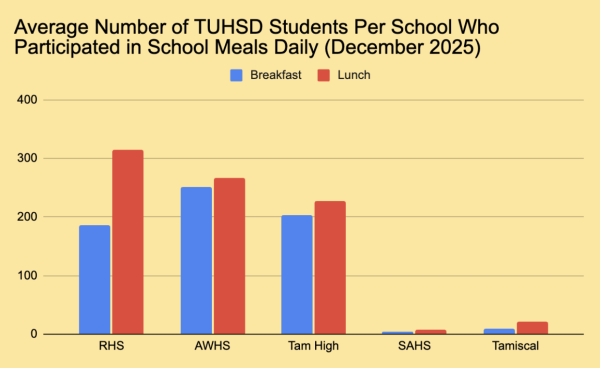
How healthy is too healthy? Beginning in the 2027–2028 school year, a new United States Department of Agriculture (USDA) regulation will cap added sugars in school breakfasts and lunches at 10 percent of total weekly calories. 20 percent of Redwood students use the school provided lunch system daily, and 10 percent use the school provided breakfast system daily. This new regulation could signify drastic changes in overall cafeteria usage and dietary habits.
For Redwood and other schools nationwide, added sugars account for about 17 percent of calories in school breakfasts and 11 percent in school lunches, according to the Dietary Guidelines for Americans.
According to the Centers for Disease Control and Prevention (CDC), Americans between the ages of 2-19 consume an average of 66 – 80 grams of added sugar per day. Furthermore, according to the Dietary Guidelines for Americans, about 70 to 80 percent of school-aged children currently exceed the recommended limit for added sugars.
The 10 percent rule is aiming to reduce added sugars and address the numbers which show adolescents exceeding recommended sugar limits.
Ben Guyton, director of Student Nutrition Services in the Tamalpais Union High School District, said that he had concerns about the future regarding student participation in cafeteria food as a result of the 10 percent restriction that has not yet been implemented.
“At some point, when sugar and sodium are reduced too much, the food stops tasting like food,” Guyton said.
Guyton also questioned the policy’s effectiveness.
“The policy isn’t really designed to manage students’ sugar intake outside of school, and as such can’t realistically [manage students diet’s as a whole],” Guyton said. “There is no rule requiring students to visit the cafeteria. It ultimately boils down to student choice.”
Sophomores Maya Tucker and Berkeley Smith, both members of Redwood’s nutrition committee, believe that the potential for decreasing student numbers in the cafeteria isn’t due to the fact that the food is becoming “too” healthy. There are just simply more appealing food options.
“I don’t think healthiness is the main issue,” Smith said. “It’s more about the wide array of food choices that students have access to, such as Red Boy Pizza down the street.”
This school year also marks the first year in which added sugar limits were put on individual items by the USDA.

(Jimmy Centeno)
As of this year, breakfast cereals have been limited to no more than 6 grams of added sugars per dry ounce, yogurts at 2 grams of added sugars per ounce, and flavored milk may have no more than 10 grams of added sugars per 8 fluid ounces.
Based on Guyton’s observations of student engagement this year under the individual item limits, Guyton can somewhat draw conclusions about what the 10 percent policy playout might look like in the ‘27-’28 school year.
“Although the policy may lead to a decrease in student participation, when it comes to choosing whether or not to use the cafeteria food, student motives have remained unaltered,” Guyton said. “Students consistently choose foods that are quick, portable, and easy to eat later, which is why options like cereal remain the most popular breakfast items.”
According to Smith and Tucker, student input matters when it comes to making the cafeteria an intriguing option for the student body as a whole. As part of the nutrition committee, Smith and Tucker’s job is to taste different food options that are within USDA regulations that may be more inviting to cafeteria-goers.
“It seems that the only way to keep students coming back is by creating entirely new recipes that are exciting and may seem more sugary on the surface,” Tucker said. “Other than that, only convenience matters to students.”
Tucker and Smith remarked that nutrition isn’t a very exciting topic for the student body. The health benefits from these regulations don’t really cross an average student’s mind.
“Creating a healthy atmosphere for students is the ultimate goal, and this 10 percent rule is a step in the right direction,” Guyton said. “But what good is health if students don’t participate in the first place?”