
As student enrollment at Redwood declines, the question is of what this could mean for teachers and students is raised. Quiet, empty classrooms? Teachers and students having courses they love taken away from them? An environment devoid of learning past the basic course requirements?—
According to a 2025 California Department of Education (CDE) data collection, enrollment has declined from over 2,000 students in 2020 to 1,754 in 2025. Principal Barnaby Payne has seen the shift in student body numbers from an administrative perspective over recent years.
“We were over 2,000 students four years ago, and now it’s on this slow downward descent. In a few years from now, Redwood is going to be 1,200 students. We just have fewer kids and we can’t offer everything we used to,” Payne said.
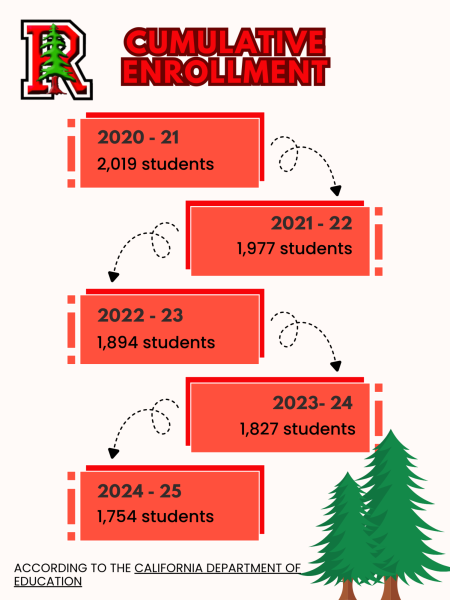
This switch isn’t confined to just a local issue, as declining numbers are affecting public schools across California. According to the CDE, public school enrollment has declined about 6.8 percent over the past decade, dropping from roughly 6.24 million students in 2014–15 to about 5.81 million in 2024–25, with decreases expected to continue.
The recent drop in Redwood’s student numbers isn’t just a trend affecting the school’s population, it is reshaping the courses offered each year.
“We may have to remove a course if there’s not enough interest. Enrollment is 100 percent the biggest factor [when choosing to remove a course],” Payne said.
Payne said that, as a large school, Redwood has been able to offer a wide selection of courses in the past. But as enrollment declines, courses that have lower popularity in the overall high school curriculum could be in danger in upcoming years.
“As a large comprehensive high school, because we are so big, it allows us to offer a lot of different programs: academic programs, athletic programs [and] extracurricular programs. As our enrollment goes down, there may be less interest in some programs to the point that they’re no longer sustainable,” Payne said.
However, declining enrollment is not the only factor that is limiting course options for students. According to Payne, the school’s available funding, in combination with lowering numbers, greatly affects course offerings. This is because the school has a budget that they have to ensure can cover all necessary issues within the school.
“We are a school and don’t have an unlimited resource paradigm,” Payne said. “We don’t have so much money and staff that we can offer every single class students choose, so sometimes we have to make hard decisions based on our course signups. Usually, depending on the course, subject and grade level, we may have to remove a course if there’s not enough interest. Primarily, that’s around electives.”
Astronomy was removed from Redwood’s course options in 2024 due to its low numbers of student interest on course selections. Sophomore Giorgia Crook had planned to take the course this year, but was unable to after learning it would no longer be offered.
“I was really excited to take Astronomy. My brother took that class and really liked it, and since I really like space, I thought it was perfect,” Crook said. “A few weeks after I put it on my request, I got an email saying that not enough people were taking it, so I couldn’t do it any longer and had to pick a new [course].”

Alongside the negative effects of course cuts on students, teachers are also being impacted. Passionate teachers who love teaching or were excited to teach a class can face disappointment when their class is taken off the roster.
“You have teachers who are just so fired up about their classes. You know, it’s a beautiful thing, so it is a sense of loss and frustration when we can’t offer some of these classes,” Payne said.
Michelle Ceja, an Advanced Placement (AP) World and Social Issues teacher, was hoping to teach the semester-long Women’s History class this fall but was unable to because it was cut. She was going to inherit the course from teacher Ann Jaime, and was hoping to incorporate more women’s history knowledge using lenses of anthropology and sociology.
Ceja said that the course was ultimately cut last year due to a lack of sign ups and interest.
“[Jaime and I] worked together to try to get sign ups last year, but we also were facing cuts. We did not have enough signups for the course this year. It wasn’t advertised or put on the catalog due to the more cuts that happened this year,” Ceja said.
Sophomore June McKeon, Vice President of the Women in Politics Club, said that it was personally discouraging to see electives like Women’s History get cut from course selections.
“I transferred to Redwood for better class options, hoping that I could find unique, meaningful classes that I could have more of a choice in,” McKeon said. “To see such a unique class that could probably change perspectives being taken away kind of feels like defeating the purpose of our many [course offerings].”
Despite not enough interest to keep Women’s History on the course offerings, McKeon said that the cuts could still have a big impact on those who were interested in taking Women’s History.
“I think they’re cutting [Women’s History] thinking that few people will be disappointed, but the few people who are disappointed are really disappointed.” McKeon said. “Because if you’re taking Women’s History, you love women’s history.”
Ceja said that she was worried for students’ learning and for the school environment if courses like these continue to get cut in the future.
“We as a school are under pressure to cut a lot of electives. It’s making it harder for us to run these classes that are not academically required but [provide] fulfillment, personal growth and enjoyment. It’s really important that students know what’s happening, because what does school look like when we don’t offer these courses? What does school feel like when we don’t have spaces to talk about these things?” Ceja said.
Courses are intended to expand students’ knowledge. The concern with cutting courses, expressed by McKeon, is that students will be deprived of important learning that could influence their developing views and values.
“Oftentimes people use ignorance as an excuse to mistreat others,” McKeon said. “I always think it’s important to teach all sorts of history, to learn about all issues of great importance, so ignorance cannot be used as an excuse.”
McKeon expressed her disappointment in the way courses and electives are being weighed and handled at Redwood right now.
“Redwood’s supposed to be better. We’re supposed to be investing in our students. We’re supposed to be having greater opportunities. We should be having more classes, we should not be cutting classes,” McKeon said.
Ceja said that losing these classes takes opportunities away from students hoping to explore other interests.
“There should be some space for inquiry and exploration of what people enjoy here at Redwood, and it’s not happening,” Ceja said.
Read more about the causes of declining enrollment: High housing costs: Erasing students from Marin