“Take that beta blocker, girl,” said “I Love LA” creator Rachel Sennott. “Numb is in,” she added. The Gen Z starlet went viral with her bold confession to a reporter last year, attributing her laid back, “messy girl” persona to the mysterious blue tablet. More recently, in a segment of “Feeding Starving Celebrities,” host Quenlin Blackwell and Charli xcx jokingly made light of the physical side effects of the drug, referring to it as “a look.” It seems that suddenly, beta blockers aren’t just a prescription, they’re a punchline, a personality trait, and for some, an “it” drug.
Beta blockers are a class of medications that work by lowering heart rate and blood pressure, reducing the physical symptoms of anxiety like shaking and a racing heart. The medication has long been known to treat certain mental illnesses, with breakthrough research in 1966 from The Lancet medical journal revealing that propranolol (a type of beta blocker) could be beneficial for patients with anxiety. Before this discovery, beta blockers were primarily prescribed to older patients with cardiovascular conditions. However, over the last 10-20 years the use of propranolol (and other beta blockers) to treat anxiety has skyrocketed, more than doubling in prescriptions according to ScienceDirect.
The physical effects of beta blockers lead to reduced nerves, creating a positive feedback loop between biological and physiological responses. This, in turn, delivers what many patients describe as a “numbing” effect. This may explain why the medication has seen an increased popularity with entertainers and public figures, given its ability to suppress the physiological reactions of stagefright, for example. Today, it’s easy to understand why young people may begin to view beta blockers, as well as other nerve management medications, as a “magic pill” to treat day-to-day anxiety.
Whether or not pharmaceuticals should be the primary treatment for patients with anxiety has been an ethical debate between medical professionals for decades. Board certified psychiatrist Dr. George K. Lerner, Medical Doctor (MD), has a complex perspective on the dilemma, but expresses concern for influential names endorsing the use of beta blockers as a treatment for anxiety.
“Something important that people don’t think about is opportunity cost. When you use medications to calm down your body, you’re also preventing yourself from learning how your body responds and how to control those things naturally,” Lerner said. “If somebody comes to me and says, ‘hey, when I’m giving a speech, my hands are shaky and my heart is racing…’, should I offer them a beta blocker or should I tell them, ‘you should take some more public speaking courses and do better’? It’s a tough one.”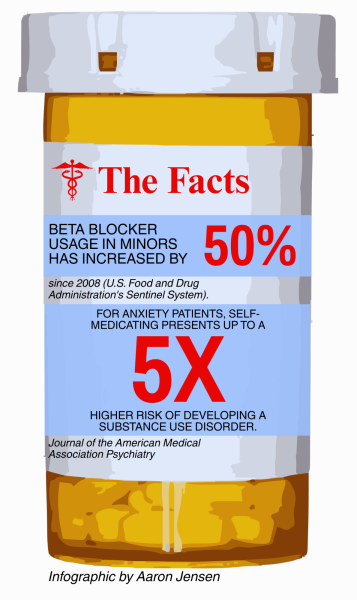
As the reach of celebrities expands to younger audiences, concerns have historically been raised about their ability to influence purchasing habits. A 2025 Youth Pulse survey found that 41 percent of social media users ages 15-30 made one or more purchases because of endorsement by influencer(s) they engage with. For Lerner, this fact is concerning, especially as beta blockers have significantly grown in popularity for pediatric patients. The U.S. Food and Drug Administration’s Sentinel System reports that usage has increased by over 50 percent since 2008.
“I think that [teens] should not approach medications in the same way that they approach consumer goods,” Lerner said. “They [influencers and celebrities] tend to trivialize the risks of these medications…I worry that their ability to make a decision is going to be impacted by the perceived popularity of that medication.”
Nonetheless, beta blockers have proven to greatly benefit patients with anxiety by reducing physical symptoms and improving performance during high pressure situations. Redwood High School Wellness Coordinator Spencer DeWoody works as a licensed social worker and understands the importance of taking a holistic approach to treating anxiety. Still, he acknowledges that medications can be vital for those who struggle with severe cases.
“To be fair to some folks, anxiety can be crippling to where it’s a necessary next step to get [beta blockers] to manage it to a level to where they can work on some of those other things. I do see the benefit of initiating it to where they’re in a space where they can do the work,” DeWoody said.
Experts agree that monotherapy (addressing a health condition with a single treatment, usually a drug) is generally a less successful approach to treating anxiety than a combination of treatments. In fact, a 2008 study from the New England Journal of Medicine (NEJM) showed that 80.7 percent of youth patients (ages 7-17) with anxiety who underwent a combination of anxiety treatments (including both medication and cognitive-behavioral therapy) saw significant clinical improvement. In comparison, the study revealed that only 54.9 percent of patients who took medication alone saw the same results.

“Thinking ‘I’m just going to take this pill and I’m going to feel better,’ is troubling and concerning to me. Specifically when we’re talking about anxiety and depression, those don’t just go away because you’re taking medicine. There needs to be more internal work to understand why these things are showing up for us,” DeWoody said.
Redwood psychology teacher Jonathan Hirsch educates students on a wide variety of different anxiety treatments. Like Lerner, Hirsch understands that teens can be easily influenced by the content that social media platforms feed them, which can become especially dangerous when the discussion of anxiety medications arises.
“We all want to feel like we belong, and some people get that by following a celebrity or modeling their life after someone that they look up to in Hollywood,” Hirsch said. “I feel like there should be consequences for celebrities that endorse pharmaceuticals. Even if only a few people use them, that’s potentially dangerous.”
The situation becomes even more complex when big names like Khloè Kardashian are going on record, confessing to obtaining beta blockers under the table in order to miraculously suppress stage fright. A study published by the University of Jordan in December 2024 revealed that 58.6 percent of surveyed medical students who reported taking propranolol for exam stress management did so without medical advice. The obtaining of beta blockers without professional support is medically risky. Research indexed by the National Center for Biotechnology Information says that professionally prescribed medication offers a 60–85 percent likelihood of significant improvement for patients with anxiety. On the other hand, a study from Journal of the American Medical Association Psychiatry revealed in 2011 that self-medicating presents up to a five times higher risk of developing a substance use disorder.
Hirsch believes a critical facet of addressing a culture that endorses pharmaceuticals is encouraging young people to speak with a professional or even simply a parent or guardian before jumping to conclusions when deciding how to treat anxiety. This of course requires professionals and trusted adults shifting towards a more open and honest conversation about medicating anxiety.
“I think that [parents are] judging it by shutting it [conversations about beta blockers and other anxiety medications] down. These kinds of things fester in dark places. When we tell kids, ‘No, you can’t talk to me about that. Go over there and be ashamed of yourself,’ nine out of ten of them aren’t going to say ‘God, what was I thinking?’” Hirsch said. “Most would think ‘I’ll just talk to someone else who’s more likely to agree with me.’ Being approachable is really important.”