
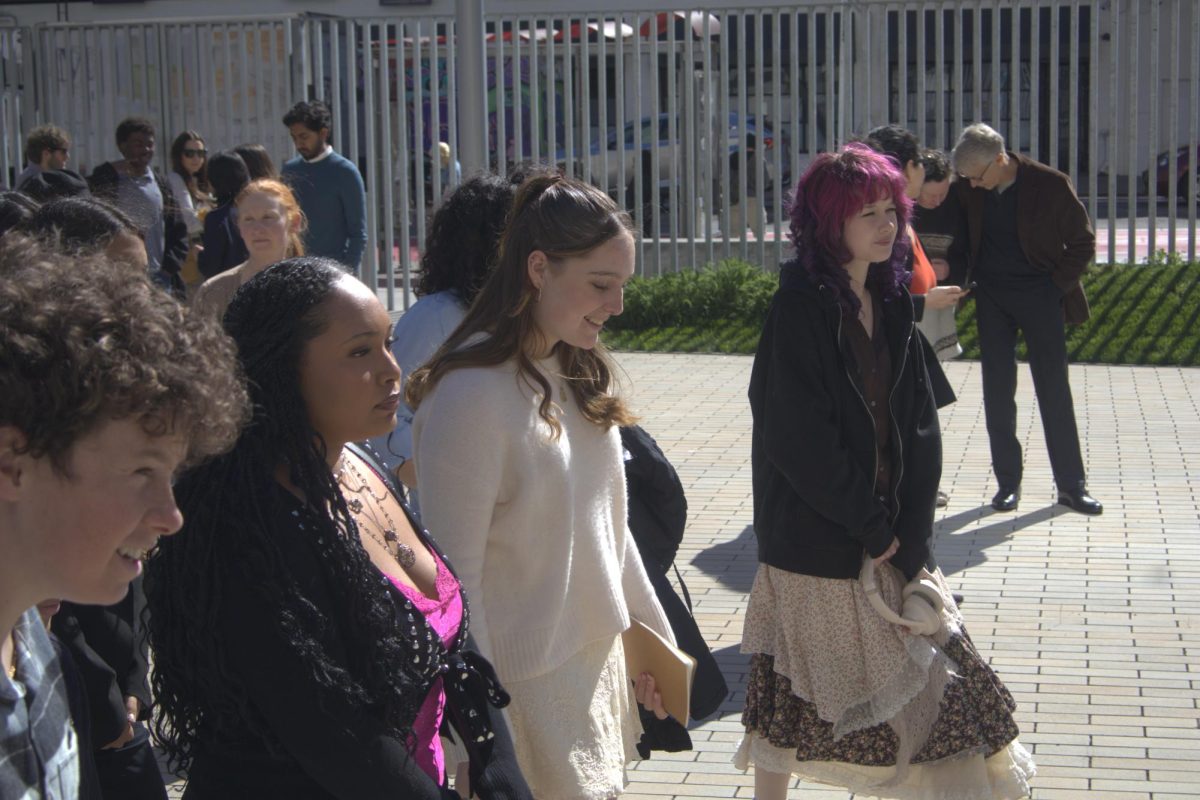
As the 18 California youth suing their government walked into the James R. Browning courthouse on March 5, 2026, supporters cheered and held up signs along the courthouse walls. The courtroom, the Ninth Circuit Court of Appeals, was packed to the brim. The 18 students had spent their lives being affected by climate change through fires, flooding, extreme temperatures and more, and were taking a stance through litigation.
Three years ago, these 18 kids from across California filed a lawsuit against the Environmental Protection Agency (EPA), in Genesis v. EPA, asserting that the EPA had “discriminated against them as children by discounting the economic value of their lives and their future when it decides whether and how much climate pollution to allow.”

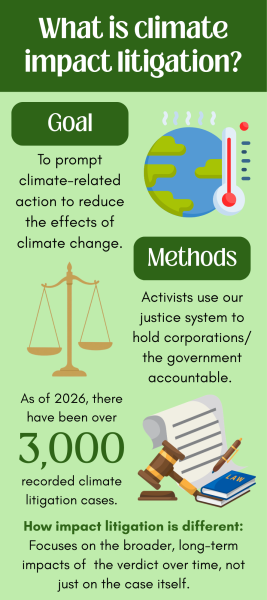
But they were far from the first to take climate change to the courts; in fact, Marin County filed a lawsuit against 32 fossil fuel companies nine years ago, including Chevron and Shell, to hold them accountable for climate deception and the harmful effects of climate change. These are just two examples of climate impact litigation cases that are still open and in progress today. Impact litigation is intended to create real change surrounding the subject, in this case, climate change and the EPA or the fossil fuel industry, beyond the lives of the individuals in the case.
Redwood parent Megan Acevedo is secretary for the board of directors of Our Children’s Trust, a non-profit public interest law firm dedicated to representing youth in the courtroom as they fight for their climate rights. Our Children’s Trust is representing the youth plaintiffs in Genesis v. EPA.
“[Climate impact litigation is] always going to be an uphill battle,” Acevedo said.
Our Children’s Trust represented children in 17 different court cases in 2025, including Genesis v. EPA, which was dismissed twice by the same judge.
“You tell 50 versions of that story, and two of them stick, and eventually one of them makes it to the Supreme Court, and then you have Brown v. Board,” Acevedo said.
Brown v. Board of Education was a landmark Supreme Court case that desegregated schools in the South during the Jim Crow era. While tackling different issues, Genesis v. EPA is similar to Brown v. Board of Education in that both had the goal of creating major change beyond the individuals in the case.
On March 5, Our Children’s Trust appealed the dismissal of Genesis v. EPA at the Ninth Circuit Court of Appeals in San Francisco. They are now awaiting a decision.
Arishka J., a seventeen-year-old plaintiff in Genesis v. EPA, has been involved in activism for several years before starting with climate litigation.
“I realized that [activism] wasn’t enough. A lot of times, governments just wouldn’t listen to kids, even when we used activism, even when we organized protests and even when we really spoke up,” Arishka said. “When we have one win in litigation, it just makes it so much easier for us to keep on winning. And I think that that is something that really appealed to me, being able to set this actual precedent with the government.”
Like many of the plaintiffs, Arishka experienced climate change-related events like rampant wildfires and extreme temperatures throughout her youth.
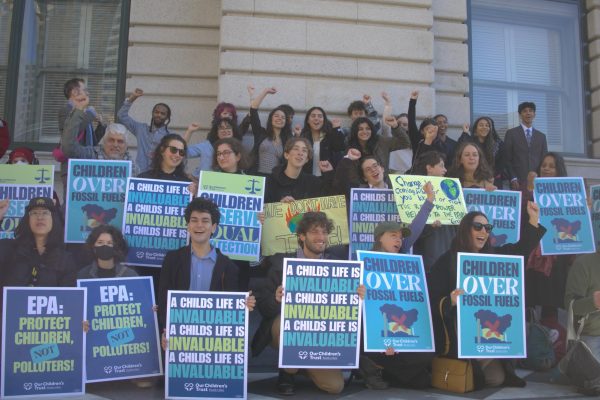
“Regardless if we won or lost this or it got dismissed after appeals or not, I think that the act of us being able to have our stories shared and represented in court is just already such a big win for us,” Arishka said.
Arishka’s first memory of climate change was during wildfire season, when she was ten years old.
“The sky was completely orange because it was wildfire season. And I was like, ‘Wow, this issue is something that’s really close to me. It’s affecting me. It’s affecting communities in California.’ Just seeing the wildfire season there was really, really tough. It really made me realize that climate change is coming, and all of these negative effects are going to affect us,” Ariska said.
At the hearing on March 5, supporters gathered to cheer on the plaintiffs and join them in the courtroom. Dave Alba, the state coordinator in Oregon with the Progressive Democrats of America, was one of them.
“I’m here to support the youth in their initiative…because I think it’s one of the most impactful ways for addressing climate change as a protected class. It’s a more expedient way to move the courts and the agencies involved to change,” Alba said.
For the plaintiffs, there were mixed feelings going into the hearing.
“I was really nervous at first, but then I was also happy, and I was really grateful that we had these amazing people representing us,” Arishka said.
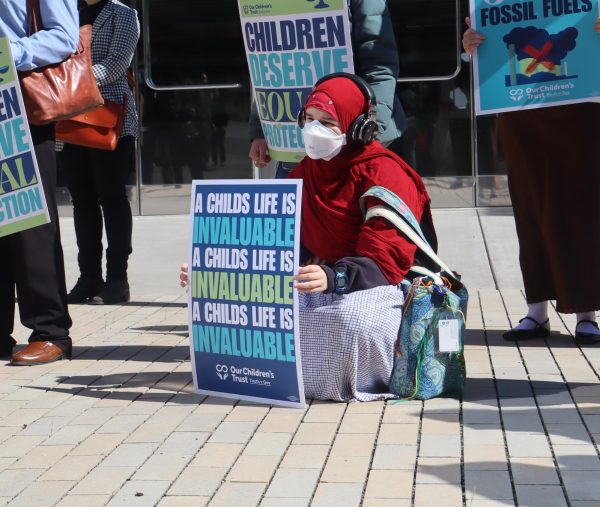
During the hearing, the judges heard each side’s oral arguments.
“It was a little bit rough to see some of the judges’ reactions to what was being brought up, but at the same time, I’m pretty optimistic, because regardless of how this hearing goes, I think that the future is really bright for this case and just generally these kinds of Youth Climate cases,” Arishka said.
Fourteen-year-old plaintiff Ione W. first experienced the effects of climate change at five years old when her house burned down in the Tubbs fire, which started in Calistoga and spread to Sonoma, Lake and Napa counties. This event developed her interest in the subject of climate change. In Ione’s community, fires are a yearly occurrence. On top of that, droughts and flooding are common as well.
“There’s no season where there’s nothing to worry about…I heard about all these things that are happening around the world and around me for years and years and years, and the only real changes I ever experienced were ones where people, where children, confronted adults and confronted the law and the government,” Ione said.
Marin is no stranger to climate-related extreme weather events like flooding and fires. According to a recent Bark survey, 15% of students’ health has been affected by smoke, and 21% of students’ lives have been significantly disrupted by wildfires while living in Marin.
Dana Armanino, the Sustainability Planning Manager at the County of Marin, has noticed a shift in community members’ priorities since extreme weather events have become more apparent.
“[Climate action has] become a more urgent need, and it definitely has gotten people’s attention,” Armanino said.
According to the Marin County Flood Control District, “Rising sea levels and more severe storm flooding as a result of climate disruption are impacting Marin County now.”
Marin County has taken action through sustainability programs, but also through legal action by filing a lawsuit against 32 fossil fuel companies, including Chevron and Shell. One of their main allegations is climate deception, meaning that the companies knew about the harm their product was going to cause and didn’t take action.
Carolyn Tsai, Deputy County Council for Marin County, is one of the attorneys representing the county in the Marin County v. Chevron et al. case.
“The core allegations here are climate deception, and the idea is that the fossil fuel companies have known since the early ‘60s that this was going to happen. The Earth was going to get warmer, sea levels were going to rise and natural disasters would increase…It’s just appalling to realize how preventable the situation was,” Tsai said.
According to Tsai, companies have also engaged in greenwashing campaigns, which use buzzwords like “eco-friendly” or “green” to improve public image without any substantial change.
“One of the chief goals is accountability…It’s taxpayer money that’s being used to fund the resilience efforts and the repair and the modification and all these massive changes to public infrastructure that need to happen to protect people from these damages…and to have the fossil fuel companies subsidize that, it feels like the just result,” Tsai said.
According to Tsai, the defendants’ main strategy has been to delay proceedings. The case has been pending for nine years.
“If you appeal everything all the time, then it’s just delay and delay and delay…They managed to spend seven years on the dispute about whether these cases should be in the federal courts or state courts. That’s a long time,” Tsai said.
The defendants have also taken advantage of the new administration in their strategy.
“Now their new tactics under Trump are also to utilize the favorable composition of the Supreme Court and to utilize Republican controlled Congress….Trump allies and Congress have proposed legislation that would effectively make litigation like this unlawful,” Tsai said.
Hearings and court documents are generally open to the public.
“What I think is most empowering about litigation is that it really allows the public in in a way that other policy or legislative efforts toward working towards similar goals may not. The defendants have to go on the record to the public, explaining their actions,” Tsai said.