When Matthew De Mello assigns an essay, he gets back over 150 papers to grade. As an English 3-4 and Essay Exposition teacher with class sizes ranging from 30 to 32 students, devoting equal time to each of his students’ work becomes a challenge.
According to the Great Lakes Center policy brief, “California Class Size Matters,” from May 2025, California educators teach some of the largest classes in the nation, “ranking fifth among the highest educator-to-student ratios in the country.”
This brief came from a statewide survey of California public school teachers, providing a look into the faculty perspective on class size. Given Redwood’s sizable classes, the question comes to mind: do school staff, including administrators, counselors and teachers, feel that large class sizes impact their ability to connect with students?

De Mello, who teaches five classes a day, has seen firsthand how large class sizes affect students.
“I find that when you have a huge class, there are certain students you leave behind,” De Mello said.
Social Studies teacher Lindsey Kornfeld said that larger classes hinder teachers’ ability to notice when students are struggling.
“If you appear stable on the outside, then, in a bigger class, it’s easier to hide,” Kornfeld said. “If a kid is stressed, but they don’t want to talk about it, it’s easier for them to kind of present another version of themself.”
Beyond personal connections, academic feedback is a critical aspect of the relationship between students and teachers.
The Tennessee Star Project, a large-scale study by the state of Tennessee which randomly placed elementary students in either smaller classes (13-17) or “regular-size” classes (22-25 students), indicated that students in the smaller classes consistently outperformed students in the larger classes on both standardized and curriculum-based tests.
Students who were placed in smaller classes during this study were more likely, as they progressed to higher grades, to enroll in advanced courses and eventually graduate from high school.
In alignment with this study, Barnaby Payne, Redwood principal and previous middle school teacher in the San Francisco Unified School District (SFUSD), said that larger classes deter detailed feedback for students, putting them at a disadvantage.
“I think the hardest thing about a big class is timely, meaningful feedback,” Payne said. “Say you’re a student, you turn something into me, and you want to know how you did, but not just a letter grade in red pen at the top. You really want feedback that’s going to help you be a better student, and as the class size gets bigger and bigger, it’s really hard to give that.”

De Mello also said providing detailed feedback is an important part of his role as a teacher. However, too many students and limited class time can impede on his ability to provide thorough critiques.
“It takes a long time and kids want their grades,” De Mello said. “But if I’m giving you an essay, it’s my obligation to help you be a better writer, and if I’m trying to make you a better writer, I have to tell you or show you the ways to get there.”
The size of a class can also influence students’ in-class engagement. Kornfeld said that at Redwood, when more and more students are packed into one class, the feeling of a close-knit community is lost.
“You have to be really confident to want to volunteer in a big class, especially if you don’t know the answer, because there’s potentially less classroom community,” Kornfeld said.
In larger classes, De Mello noticed that some students prefer to keep to themselves more.
“You have other kids that don’t do as well, that don’t ask for help, and just sort of fall away,” De Mello said.
In contrast to Redwood, Marin Academy, a private high school in San Rafael, offers a smaller, more intimate learning environment.
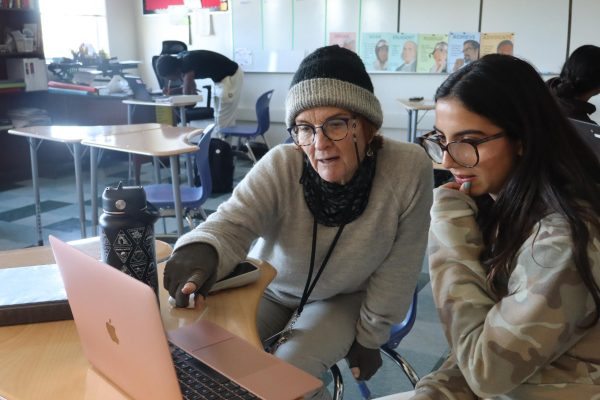
Norma Calderon, a first-year Spanish Level 2-3 Honors teacher at Marin Academy, teaches three honors classes with 14 students each. She said that she has had a positive experience with student participation and attributes it to smaller class sizes.
“For the most part, the students in my classes are really confident and they won’t stop asking questions until they have clarity,” Calderon said. “I think that perhaps the smaller classes give them the confidence to ask.”
Calderon said that student-teacher connection isn’t solely dependent on how many students are in the room. It is also the teacher’s responsibility to foster these relationships.
“I think the key thing for my students to participate is for me to create a safe space for them to take risks,” Calderon said. “I think it really has to do with the kind of relationship you build in that classroom, the culture. If you build a culture of ‘It’s okay to make mistakes’ and ‘Let’s make mistakes all the time and just roll with it,’ then it’s easier for students to take a risk.”
Like teachers, counselors are tasked with forming connections with numerous students.
Tami Wall, a Redwood counselor assigned to 325 students, also said that such a large student-to-staff ratio can delay meaningful one-on-one interaction until later in high school.
“I love that we get assigned to our students when they’re in eighth grade, and we stay with them for the next four years,” Wall said. “So I do get to know my students over time, but we don’t see them three days a week, like the teachers do.”
Wall introduced a possible solution to this lack of time between students and their counselors.
“I think it’s just a fast-paced environment, and we’re not part of your bell schedule, so we have to be booked by appointment or SMART period to see you,” Wall said. “I’d love it if counseling could be part of our daily school structure.”