
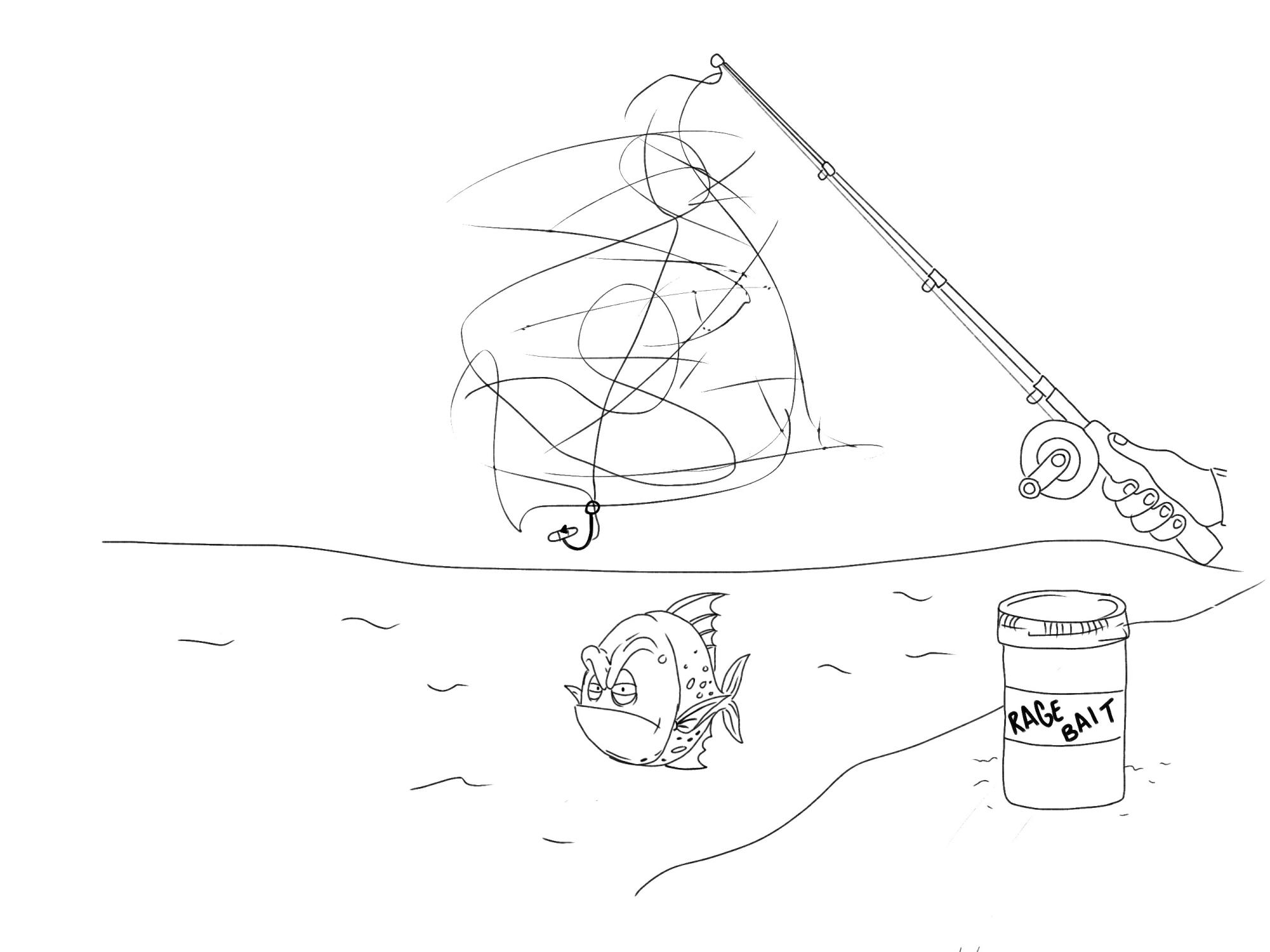
Have you ever been fishing before? Well, if you have, you’re in luck. If you haven’t, you may be unfamiliar with how annoying it is when a fish ignores the bait and swims mindlessly around it instead. And if you’ve anticipated the thrill of catching a big, beautiful fish but failed miserably, you may have felt the rage that twists in your stomach. That is what it feels like to be rage-baited. However, in most cases, rage-baiting doesn’t occur with fish—it occurs in real life, with people who decide that rage-baiting is their new personality trait.
For those unfamiliar with the term, rage-baiting refers to “content that tries to provoke anger or outrage, as a means of gaining attention,” according to Merriam-Webster. This content is seen on social media posts, comments or accounts, intending to poke fun at certain creators or relevant, trending topics. Rage-baiting has created a new form of conversation that is intended to be humorous but is instead aggravating. There are many forms of rage-baiting, though these two stand out the most:
- Mutual rage-baiting
Say you’re eating lunch in the car with your friends. While discussing the latest news or gossip, two of you start to sarcastically make fun of the way someone said a certain phrase or sentence in a weird way. It’s mutual, and as friends, you agree that this form of rage-baiting is clearly lighthearted and humorous.
2. Irritating rage-baiting with the intent to aggravate
This form of rage-baiting comes from someone other than your friends and is usually meant to irritate or annoy. The number of times I’ve heard the phrase “It’s just rage-bait,” or “Don’t take things too seriously, I’m just rage-baiting you,” is absurd. Yet it proves that people often seek to anger others for no reason. And sometimes when people mess up or take things too far, they feel bad about their actions, and rage-baiting is the perfect cover-up.
Nevertheless, rage-baiting can undermine someone’s confidence and provoke anger based on how they interpret your point of view. The body and mind’s reaction to this stress can have an immediate effect. According to Newport Healthcare, “Rage-baiting stirs up natural human psychological and physiological responses. Anger is a powerful emotion that activates the body’s fight-or-flight system. This can trigger a stress response that includes increased heart rate, shallow breathing, heightened alertness and a flood of stress hormones.” In fact, according to a January Bark survey, 38 percent of students reported feeling frustrated when they are rage-baited, indicating that teens feel the need to defend themselves in these situations.
Some people believe that rage-baiting teaches younger generations to care less about the small things and to have a good time. When done right, rage-baiting is just a funny trend with good intentions that shouldn’t be taken too seriously. In addition, some believe that if you can’t handle the joke, you should consider how letting things go could make your life a lot easier. However, all of this is easier said than done. It’s difficult to let something go when deep down you feel hurt or annoyed by what someone has said, especially if it’s something you’re passionate about.
Now rage-baiting isn’t entirely bad. It’s important to have fun and laugh about the small things, but it should never be an excuse to make fun of something that isn’t a joke, even if the intentions are lighthearted. Having a “just get over it,” or “it was just a joke” mentality will not get you far and will only push people away from you by aggravating your peers. Knowing the right time, place and audience is crucial in having the awareness about whether to reel in the bait.