Seed oils. They’ve been called everything from a “silent killer” to a “heart-healthy staple,” depending on who you ask. Their popularity has spread throughout TikTok and even among national politicians. What started with health influencers and podcasters has transformed into a national debate over this one question. How bad are seed oils, really?
National health secretary Robert F. Kennedy Jr. and his Make America Healthy Again (MAHA) agenda have weaponized the topic and taken a strong stance against the consumption of seed oils. However, science says otherwise.
The Cleveland Clinic of Health refutes claims that seed oils are inherently toxic and emphasizes that, in moderation, seed oils can support a healthy diet. Despite this, the MAHA campaign continues to insist that seed oils are one of the leading causes of obesity (AP News) and that Americans are being “unknowingly poisoned.” These accusations aren’t just misleading; they directly contradict decades of nutritional research. The truth is simple: The panic around seed oils isn’t based on science; it’s based on politics. When misinformation becomes a political tool, public health becomes the casualty.
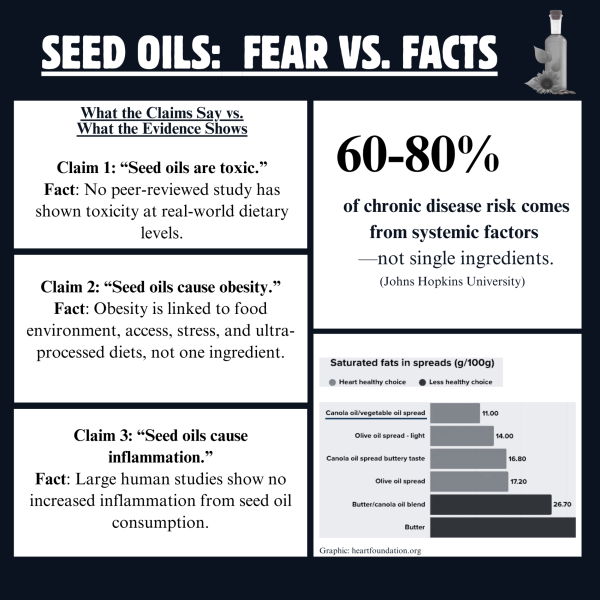
Not only does MAHA fail to produce credible evidence that seed oils cause health crises, but according to KTVU Fox San Francisco, Kennedy has cited research papers that do not exist in an attempt to legitimize his stance on seed oils. When a national health agency relies on fear-driven messaging, they reveal a political agenda, not a public health mission.Some critics of seed oils argue that highly processed food, many of which contain these oils, can contribute to health issues and that Americans should be aware of what they’re consuming (Stanford nutrition). But this critique targets the overall food system, not seed oils themselves, and it does not justify MAHA’s unsupported claims that seed oils are dangerous.
So why attack seed oils with no substantial evidence of their supposed harm? Controversy generates attention, which in turn generates political power. The anti-seed oil narrative fits into a broader pattern of simplified, fear-based media that aligns closely with the communication style of the Trump administration.
Kennedy launched his crusade against seed oils and obesity during his 2024 presidential campaign, which he later withdrew from in exchange for a place in the Trump administration. Despite lacking medical training and having a history of drug use (PBS), he was appointed National Health Secretary after Trump’s re-election, raising questions about qualifications and political loyalty. In office, Kennedy has made other false claims in addition to the seed oil allegations, including that taking Tylenol during pregnancy causes autism, lacking scientific backing. This pattern reveals that Kennedy’s health messaging is driven not by evidence but by political ambition. His willingness to promote sensational, unproven theories to gain influence directly supports the argument that the seed oil panic is a political strategy, rather than a public health warning.
When political leaders push simplified explanations for complex health issues, it becomes easier to shift blame onto ingredients like seed oils rather than addressing deeper systemic problems such as food access, education and healthcare inequality. This strategy creates a clear “enemy” for the public to rally against. By turning nutrition into a political battleground, MAHA distracts from real, science-based solutions that could improve public health. MAHA misinformation is creating fear and harm, raising questions about whether we can trust our government with public health.
As students and consumers, it’s essential to recognize when a health trend is being exploited as a political tool rather than a guide supported by credible scientific evidence. The seed oil panic is only one example of many misinformations that can spread quickly when amplified by social influence and government officials. Staying informed, questioning bold claims and examining trusted scientific sources can help cut through the noise and keep us focused on supporting our health instead of what makes headlines.