
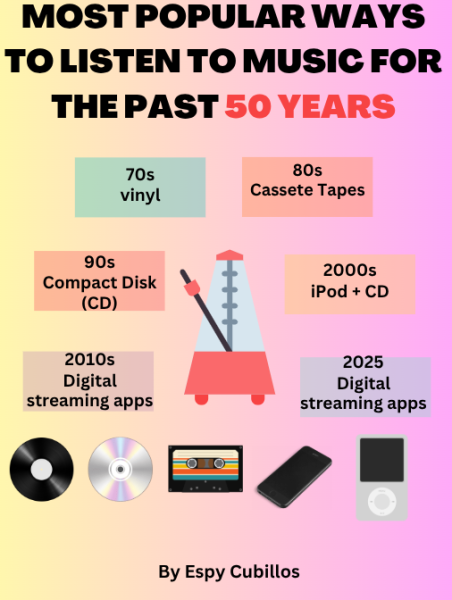
In today’s world, there are more music genres, artists and technology than ever before. However, there once was a time when analog music, live music and radio were the only options. Historically, the most popular format for listening to music was constantly changing, whether that be vinyl in the 70s, cassette tapes in the 80s or Compact Disks (CDs) in the 90s. Everything seemed to be temporarily popular until it got replaced by the “next big thing.” However, when digital hit the music market in the mid-2010s, society broke that trend, and digital music has maintained its popularity by a majority ever since 2016.
According to the Recording Industry Association of America’s (RIAA) 2024 end-of-year report, the vinyl market produced $1.4 billion in revenue, and streaming platforms like Spotify or Apple Music collectively produced $14.9 billion in revenue. This begs the question of whether or not analog (physical) music will ever make it back.
With the growing popularity of smartphones, music can be played anytime, anywhere. Whether someone is listening to their playlist on the way to school, studying with their AirPods in or blasting their speaker at a sports practice, streaming apps seamlessly integrate music into everyday lives.
Musician and Redwood senior Claire Fago prefers listening to digital music for its convenience.
 “When I listen to music, it’s usually when I’m out and about, so [digital is] the easiest way for me to access [it because] I always have my phone,” said Fago.
According to The University of Northern Iowa, “Digital music technology gives consumers access to millions of songs for one low price in one location in a way that was never possible before.” On average, digital streaming platforms offer listeners free plans with advertisements or the average streaming plan of $10.99 to $12.99 per month, globally recognized as a complete shift from traditional analog technology’s $25 record with $100 to $1000 for the turntable and stereo equipment.
“Vinyl is pretty expensive, which is another reason why it’s not my primary listening source…[and since] I always have my phone, free music is always accessible,” said Fago.
Digital streaming platforms also harbor the ability to connect with others. Whether it is creating a joint playlist, sharing songs with friends or following your favorite artists, digital continues to advance.
Apps such as Spotify also have “daily mixes,” personal artificial intelligence DJs, and radios for your most-listened-to artists, all of which uniquely resonate with every listener and truly sets digital apart.
But Spotify is not the only digital platform that taught the world music could break boundaries; Qobuz did too. Unlike most mainstream music apps, it was designed for audiophiles, people who are passionate about sound quality. Qobuz offers a plan at $14.99, in exchange for lossless audio, that mirrors the high-quality of a vinyl.
Qubuz does this through lossless audio, audio that hardly loses any original sound after compression. Compared to most streaming platforms that use lossy audio, audio that noticeably decreases in quality after compression.
Given that Qobuz only attracts around 200,000 subscribers compared to apps like Spotify or Apple Music, which have tens of millions of subscribers, the vast majority of people are just fine with compressed audio quality.
For those who collect vinyl or audiophiles who tune in to the sound, the emotional connection to the music is a major pull factor. Picking up a vinyl, examining the artwork, and hearing a needle trace the grooves can almost instantly bring some listeners back to their childhoods. Especially with adult listeners, many have inherited a vinyl record passed down through generations of their family, making it not just history but also a physical symbol of a loved one.
Junior Maddy DeBisschop has a record player and an Apple Music subscription, but voiced her family’s tradition of playing vinyl.
“It’s nice [to] do something that [my family] can relate to [since] my grandparents [and] my parents used vinyl,” DeBisschop said.
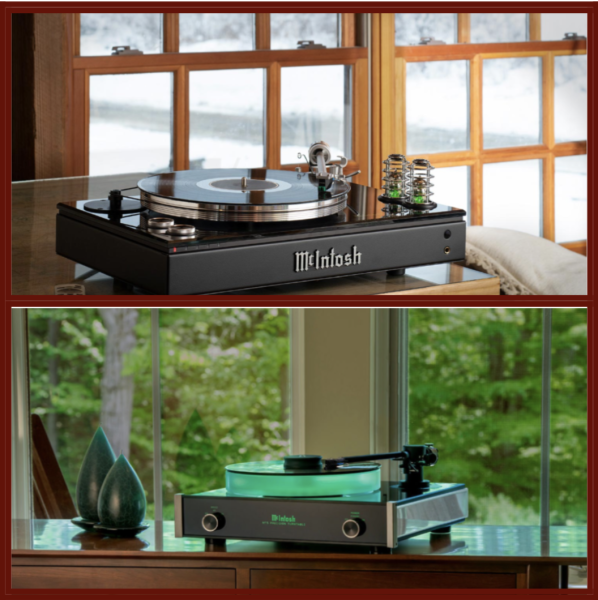
Hearing vinyl’s lossless, real, raw quality, almost identical to the original recording, can even make one feel like they are reliving old memories, giving some listeners a rush of nostalgia to hear it again.
For Bes Niviera, the global ambassador of Music Direct, the world’s largest online retailer of high-end audio, vinyl plays a significant role in his life.
“I wanted to hear James Taylor’s Greatest Hits. There’s a room of people in front of me. I get ready to put the record on the turntable, and for a moment I start cracking and getting ready to cry, because the track that I wanted to play for them is the most meaningful track of my entire life,” Niviera said. “So I said to this room of people, with tears, praying, ‘I’m so sorry, but I need to play this record because this record means so much to me.’”
The emotional connection is a major reason why people are willing to pay more for physical high-quality sound systems when streaming is practically free. Additionally, because vinyl costs more, it encourages active listening with minimal distractions to make the most of their investment. With analog, listeners are seeing music as not just background noise, but a more present experience.
“I feel like with my vinyl, I can spend less time on my phone, which is nice [since my] phone is really distracting and [listening to my record player is] a nice way to just decompress,” DeBisschop said.
McIntosh, a luxury audio brand, is recognized as one of the most iconic brands for stereo systems and turntable equipment in the world. Ken Zelin is the global training manager for opening and sales training at McIntosh. He explains how vinyl is a physical object that requires listeners to interact with it, but in return, they get to own a piece of music.
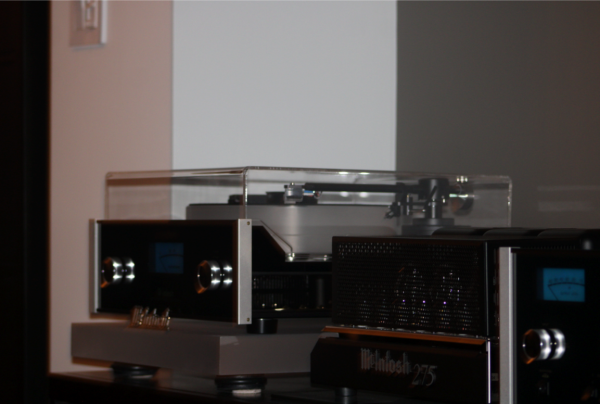
“With a record, there’s a little bit of work involved, and that just psychologically is very satisfying for people,” Zelin said.
Both digital and analog have advantages of their own, so at the end of the day, it’s up to the listener to decide what audio source they use. Finding their preferred way to listen to music not only leaves listeners feeling rewarded afterward but also gives them a more meaningful and personal connection to the music itself.