Social media has become a way for communities to form and connect through shared niche interests. While these community interests can range from water bottles to vinyl, both can be successful in establishing a sense of belonging in their members. These items are harmless on their own, but problems arise when big companies begin capitalizing off the interest in these items. The personal expressions you see online are just trends — social media draws people into communities that are fueled by consumerism. Social media has become a trap for users because of the corporations that have exploited genuine communities and self-expression for profit.
A perfect example of consumerism in social media is the rise of water bottle collections. Often referred to as “WaterTok,” collecting reusable water bottles has become a prominent trend on social media platforms.
It seems that there is always a new water bottle to have: it first began with Hydro Flasks, then moved onto the Stanley Cup and is currently focused on the Owala. Online, it may seem beneficial to get these water bottles because you’re drinking more water and staying hydrated. However, WaterTok has created serious waste rooted in its consumeristic tendencies. The Invading Sea found that reusable steel water bottles take a significant amount of energy to produce, starting with iron that is mined and then smelted into steel. This process outputs pollution which further heats up the Earth, therefore speeding up climate change. Just because these water bottles are reusable doesn’t mean they are completely clear of climate harm, and people collecting multiple colors of each isn’t aiding environmental crises. Owning one reusable water bottle is far more sustainable than accumulating ten variants.
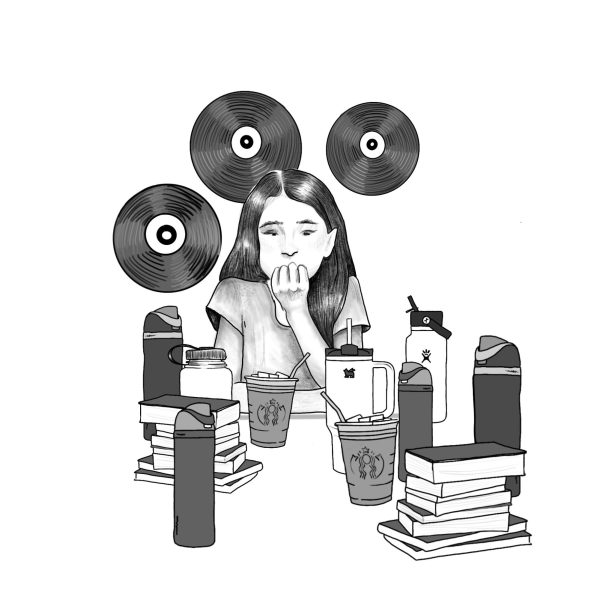
Another consumeristic, collectible item that has had a revival is vinyl records. Vinyl was first created in the mid-18th century as a way to listen to music without hearing it played live, and has been popularized again in recent years. This trend reached its peak in 2023 with 49.6 million album sales compared to 13.1 million sales in 2016 according to Luminate. Although this statistic seems innocent, Grady Newsource reported that vinyl records release 1.9 thousand tons of carbon dioxide into the atmosphere when producing four million records. So with the resurgence of vinyl, their popularity will contribute negatively to climate change.
But the resurgence isn’t solely due to consumer demands; the music industry has played the biggest part in driving interest. According to The Guardian in 2023, the Rolling Stones released 43 variants of their album Hackney Diamonds, each having the exact same track list, just with different artwork. Taylor Swift did something similar for her most recent album, “The Life of a Showgirl.” She released eight variants with different artwork, but the same track list. Certain ones were only available for purchase for 24 to 48 hours which pressured fans to buy all of them.
A similar incident occurred with her album “The Tortured Poets Department” where she marketed certain vinyls with bonus tracks, but these songs eventually became available online. Swift is not the only artist who has employed this technique, but due to her large platform she has the ability to encourage other artists to stop this pattern by setting an example.
On the other hand, artists like Billie Eilish have proven that it is possible to sell vinyl ethically. For her third and latest album, “HIT ME HARD AND SOFT,” Eilish continues to sell five variants, but all the materials and packaging used for these records are eco-friendly as she clearly notes in the description of each on her website.
Although water bottles and vinyl have become consumeristic, the communities of buyers they have created are valuable. Taylor & Francis Online found that online content can provide comfort for those who face fear and anxiety in their lives because they are a part of a community of people who share similar interests.
This kind of relationship that social media has fostered is one of the best things to come out of platforms like TikTok and Instagram. The algorithm makes it easy for people to find new interests and perspectives they didn’t have before and a fast way for people to find their people.
The problem with this algorithm is that it is also available to big corporations which takes away the authenticity because consumeristic tendencies are often promoted within these groups. Corporations aren’t there for the community aspect, they’re there to make profit off the members. It’s important to recognize this shift because it means the difference between group loyalty and brand loyalty. Think about the authenticity of the product: is it valuable to you, or to the corporation?