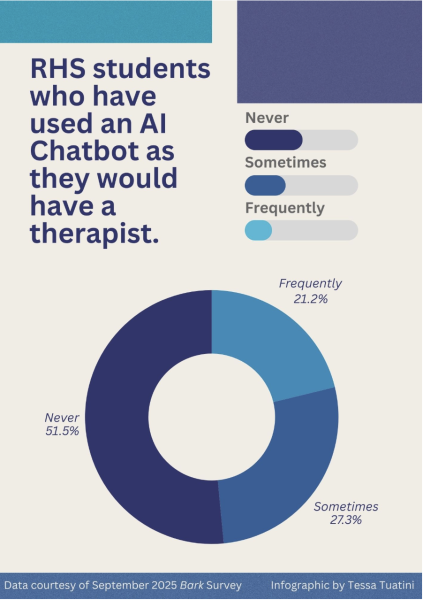
For decades, therapy has been built on human connection. Now a new form of ‘listener’ is entering the conversation, one that never judges, never sleeps, and is available 24/7. According to a recent Bark survey, 56 percent of students have used Artificial Intelligence (AI) for therapy. Hesitant to speak with a professional due to fear of judgement from their peers or not being taken seriously, these students have turned to AI as a more accessible and anonymous form of therapy. These digital solutions offer a convenient outlet for students to express their mental health struggles. On the other hand, the lack of human empathy, connection and understanding that a licensed therapist is able to provide are factors that are easily overlooked when deciding between traditional therapy and assistance from AI.
So why use AI for therapy? For many, the idea of privacy and discretion, as well as being affordable and convenient, is largely appealing. There is a strong stigma around mental health which often prevents people from openly seeking support. According to the American Psychological Association, 86 percent of Americans believe that the term “mental illness” carries a sense of shame.
Many teens are also afraid of opening up to a professional. According to Pew Research Center, only 3
1 percent of teens feel comfortable speaking with a mental health therapist about their issues.
These statistics reflect a larger trend surrounding the conversation of mental health, which is that people are less comfortable speaking openly about it for fear of being judged. Carolyn Miller is a Wellness Center therapist who works with students struggling with their mental health.
“Your family of origin has a lot of influence on what you think is good, helpful and useful for you. Some parents [and students] will say ‘That’s only for people when they’re sick’,” Miller said. “Students hear that and they think ‘If I go in there, then other people will think that I’m sick so I don’t want to do that.’”
These barriers have caused an increase in the popularity of the use of AI for therapy. Unfortunately, this trend carries significant risks.
The connection between a therapist and client is an impactful and nuanced relationship. Human therapists are able to provide clients with face-to-face appeal, as well as a human ability to form an emotional connection. Spencer DeWoody is a licensed therapist, licensed clinical social worker, and the Wellness Center coordinator. DeWoody specializes in working within schools and with teens.
“There’s something about a therapeutic relationship that really impacts the outcomes of therapy. I’m huge on saying that the relationship between a therapist and a client can really impact the outcomes on how a person feels when they leave,” DeWoody said.
AI therapists do not share this human connection, meaning that they often lack substance to their answers when consulted with important emotional issues.

“As far as any sort of meaningful outcome, I think you’re completely missing the actual relationship that’s built between therapist and client,” DeWoody said.
The lack of accountability and tendency of AI to agree with the user despite the conditions is a large concern. Katherine Klender is an intern in the Wellness Center and current graduate student at San Francisco State University.
“With AI, and if people are talking to ChatGPT, there’s this positivity vacuum that sometimes happens where it’s only validation and it’s not pushing people to seek outside help or to grow, it’s just validating your feelings even if it’s negative,” Klender said.
Another issue with relying on AI as a mental health resource is that it is not able to take the needed measures to prevent or intervene with a serious or harmful issue. While legal regulations require psychologists to maintain a strict confidentiality with their patients, in severe cases, such as abuse or serious suicidal ideation, this can be breached for the wellbeing of the client. The ability of the therapist to use their professional judgement of when to take these measures is essential to the safety of the client. Speaking to AI does not allow for this kind of intervention.
“There’s no one around you that knows what’s going on when you’re talking to AI. The nice thing about a therapist is that although people don’t initially like it, if something really serious is happening, we know when to break confidentiality and draw in a support network. There’s no one to know if you’re talking to AI if something serious happens,” Klender said.
Despite these flaws, according to Pew Research Center, 46 percent of Americans believe that AI should have a role in providing people with mental health assistance. The desire for instant and affordable support, paired with the const
ant accessibility of AI, has created a resource that is impossible to ignore.
Junior Charlotte Paul has used AI as a resource during times of stress, and even to come up with strategies to help her mental health. She explained, however, that when compared to the resource of a wellness therapist, the two were vastly different.
“An AI chatbot is overly confident in its answers and just doesn’t know you as well. It can’t really pick up your tone or emotions as well as an in-person therapist can,” Paul said.
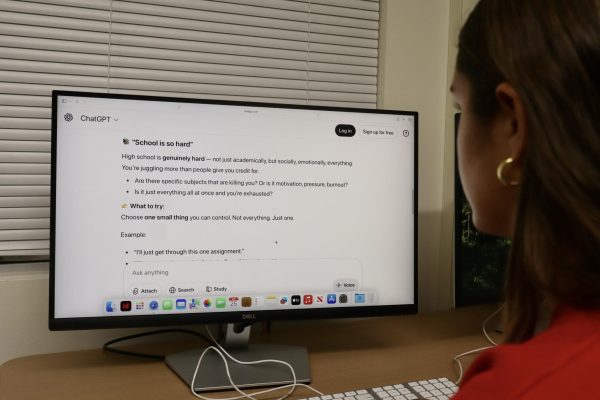
When used appropriately, AI can serve as a useful tool for students looking for guidance or a space to vent. As a resource, AI offers a private and efficient outlet for expressing emotions, particularly when the issues aren’t severe or in need of professional intervention. However, it’s important to understand the limits of what AI can truly provide.
“AI does not actually give you social support. It gives you knowledge. It gives you validation. But there’s no empathy and there’s no actual human chemistry,” Miller said.