
Every spring, students receive and flip through the new yearbook, pointing out friends, laughing at photos and remembering the best memories from the school year. While exploring the pages, however, most people don’t realize the time and effort that go into its creation.
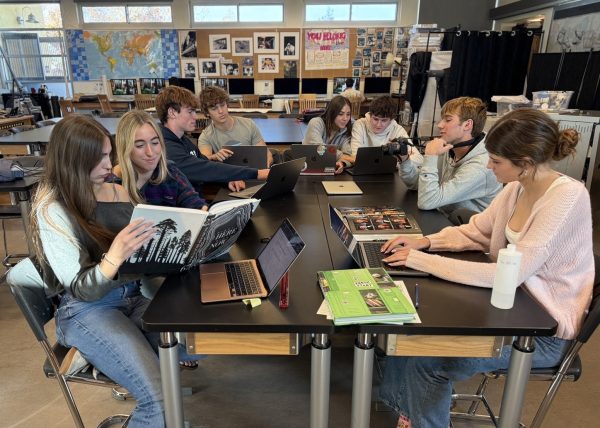
The Yearbook Club consists of a group of students who spend the entire school year designing pages, taking photos at events and creating a timeline of the year, all in their free time. The club meets twice a week during SMART period and is led by Susie Maxwell, the Advanced Placement Art History and Photography teacher.
Maxwell taught yearbook as an official class from 1999 to 2002, until former teacher Stephen Hart took over until 2022 when it was removed as an official class. Since then, Maxwell has run the program as a club.
The process of creating the yearbook begins at the start of the school year when the club initially starts planning themes and ideas.
Senior Renata Lionetti, one of the club’s editors-in-chief, explains the importance of communication and compatibility, as the entire club must agree on what goes in the book.
“We choose an overarching theme at the beginning of the year, and then we do a color palette based on that. The layouts are up in the air until we submit our first chunk of photos. We go back and forth a lot because we all have to agree on it. It’s basically a lot of trial and error,” Lionetti said.
With no designated class period anymore, students in yearbook have to use their SMART periods, lunches and personal time to complete their work.

“The work is quite time-consuming,” Maxwell said, “I do think it’s more manageable when it’s a class.”
Lionetti describes the difficulty of balancing the yearbook’s workload with her schedule and extracurricular activities.
“I’ve skipped a couple club soccer practices as well as having to work on it during leadership in the mornings, which is a sacrifice because that is another class that I should be engaged in,” Lionetti said.
Maxwell acknowledges the pressure and demand that come with creating the yearbook in students’ free time.
“It’s a lot to produce this book without it being an actual class. It’s not that my students aren’t doing the work– they all work so hard while also balancing their schoolwork, applications and everything else, which is difficult,” Maxwell said.
Despite the overwhelming workload, Maxwell emphasizes the important skills learned along the way.
“It’s a design program that the book is built off of, so they are learning crucial things like communication, creative skills and publication skills,” Maxwell said.
Lionetti said that being a part of The Log also offers numerous beneficial and meaningful experiences, the long work hours are worth it to her because of the community she gets to work with.
“I hope in the future I will remember working with these amazing people and getting to see their creative sides. I’ve also really enjoyed having a close relationship with our teacher, Mrs. Maxwell. She’s so great, and genuinely cares about the yearbook and making sure it’s perfect,” Lionetti said.
Outside of the club members, Lionetti said that she thinks the yearbook club has given her opportunities to interact with new people.
“Getting to work with groups that I wouldn’t usually spend as much time with is great. A lot of the time, we work with special education to get photos with them. And having the ability to just ask random people in the hallway, ‘Can I take a picture of you doing that?’ I just love working with all these people I wouldn’t normally cross paths with.” Lionetti said.
The club aims to include every student in candid or activity photos, beyond their basic headshot, which is harder than it seems.
“A lot of kids don’t like getting photos taken of them. It’s different than it used to be when I taught yearbook twenty years ago, people used to love getting their photos taken,” Maxwell said.
Lionetti and Maxwell both said that getting photos is a challenging part of the yearbook process.
“Seniors get especially nostalgic looking at younger classmates moving on to a new chapter that they have all lived through; they want to make sure they capture and take photos of all those moments that all students share,” Maxwell said.
Maxwell highlights that seeing students’ reactions to the yearbook demonstrates its value to the community.
“I know that people are happy to have a yearbook, and it makes me feel good to see smiles when people receive it,” Maxwell said.
When the yearbook is finally complete, it becomes a powerful reminder of why the effort pays off.
“I really enjoy the feeling of the final product being done,” Lionetti said, “The book is so big and there’s so much work being put into it. I’m already so proud of all the work that we’ve done for this year’s edition.”