While most kids his age are finishing homework or scrolling through their phones at night, Xei Sackett is playing piano. Sackett has been playing since he was three years old, and what started as a childhood activity has grown into something much deeper.
“Piano has really become a core part of who I am,” Sackett said. “I would be completely different if I hadn’t started as a little kid.”
His teacher, Jeanette Tietze, has worked with him for four years and describes how he was a quick learner.
“He was very careful when I first met him,” Tietze said. “But he was quick to make changes if I said to change the pedaling or fingering.”
Sackett is now working on level 10 of the Royal Conservatory of Music, the highest level a young pianist can reach. He’s tackling pieces like Debussy’s “Reflections in the Water” and “Chopin’s Black Key Etude.” Both of these pieces are extremely technically demanding, according to Tietze.
“These pieces take everybody a long time to learn,” Tietze said. “He’s continued to experiment with having a lot more variety in his playing.”
What sets Sackett apart as a musician isn’t just how hard he works, but his musical judgment.
“He has really good taste,” Tietze said. “He has an ability to hear if something sounds good or bad and how to change it.”
Sackett also competes in piano competitions. For the past four years, he has entered the Marin Music Chest and won each time, earning 1,600 dollars all four years. In addition to local competitions, he competes at the state level. However, he has not always seen success.
“I don’t always win, so sometimes that can be demotivating,” Sackett said. “But when you do win, it’s really satisfying because all your hard practice pays off.”
Tietze says what impresses her is not the wins or losses, but the consistency he maintains despite a hectic schedule.
“I am surprised that he continues to excel even when there are extra challenges, like having a super busy schedule,” Tietze said. “I’m surprised at how well he does.”
At school, most of Sackett’s friends know he plays piano, but few understand the level he’s at.
“They know how much I practice and that it takes a lot of my time,” Sackett said. “But I’m not sure that they know about the results that I get in competitions.”
Sackett said that while his commitment to piano can feel isolating at times, it has also helped him to form connections with new people.
“The people around me in school aren’t playing piano on the level that I am,” Sackett said. “But by playing piano I find people in the music community that I can really connect to as well. That takes away the isolation.”
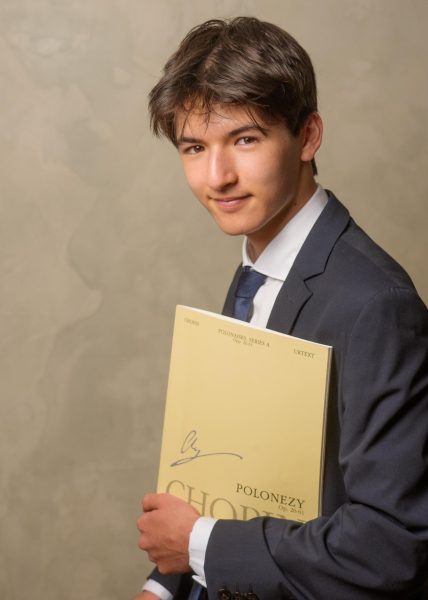
Piano has changed not only his social circle but his discipline as well. This commitment to practicing, whether he feels like it or not, has built something in him that transcends music.
“Having to practice daily for an hour, that kind of consistency has really built my work ethic up,” Sackett said. “It transfers over to school, doing homework and that kind of stuff.”
Tietze has seen that discipline firsthand and isn’t worried about where he ends up at all.
“He’s probably going to be able to figure out any type of piece he wants to play because he has a lot of background, a strong foundation and a really good technique,” Tietze said. “I think he’ll probably enjoy finding other partners, playing duets and trios.”
However, Sackett himself is a little bit more uncertain about the future. He does not see himself making piano playing a career. But walking away from it isn’t something he is considering either.
“I think piano will always be part of my life,” Sackett said. “I’ve already spent so much time on it and I do enjoy it.”
The bigger picture for Sackett has never been the scholarships, the levels or the competitions. It’s something much simpler than all of that.
“It really helps me connect to my inner emotions and express myself in ways I wouldn’t otherwise be able to,” Sackett said. “Music is just so impactful.”