
With the upcoming Advanced Placement (AP) season creeping dread onto Redwood students, their mental health takes a backseat as they prioritize their academic workloads.
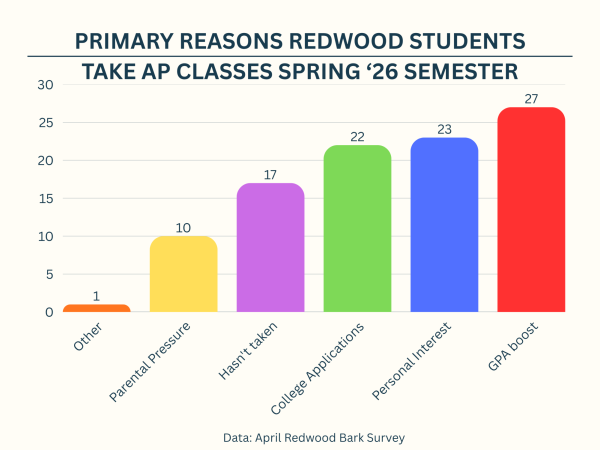
In an April Bark survey, 52 percent of Redwood students taking AP courses this year have reported feeling stressed surrounding the testing season. In that same survey, 23 percent of students chose their classes based on personal interest, while 10 percent did so under parental pressure, 27 percent for a GPA boost, and 22 percent for additions on their college applications.
Underclassmen are only offered one advanced placement class at Redwood, which is AP World History as sophomores. Therefore, it is their first AP testing season.
AP World History teacher Corin Greenberg, believes students often express their stress during this time by having lots of questions due to not knowing what to expect on the test.
“Some students worry that they’re not studying enough when they really are or they think they should start studying earlier than they need to,” Greenberg said, “the entire year is spent preparing for this test.”
Greenberg said how students in the past would “stay up all night and study” however, she disagrees with work being prioritized over sleep.
“I think they should prioritize their own wellness and managing their stress… students should hold onto the feeling that they’re gonna be okay,” Greenberg said.
The stress buildup during this time of AP testing can get overwhelming, and Redwood’s wellness office has grounding methods to help.
Wellness Coordinator Spencer DeWoody, emphasized that balance is key between both school life and personal life.
“For example, if what fills my cup is that I socially connect with people, then I should socially connect with people. If what fills me up is some other things like going on a walk, then that’s what I need to be doing with my time, not just spending it all studying because those tests do need to be studied for, but they aren’t our whole selves.” said DeWoody.
DeWoody also said that students often can feel scattered during class. Wellness provides a safe space for them to collect themselves and have someone to talk to about their situation.
Senior Katherine Lim has taken nine AP classes throughout the course of her high school career and six AP tests.
“When I’m going through a lot of studying, I try to split up my time by taking breaks,” Lim said. “In those breaks, I either call my friends or eat something.”
Despite it being important to prioritize studying, taking breaks helps give students energy to study.
Greenberg highlighted how taking breaks can even boost student performance on their tests. For many students, the stress comes from uncertainty. “In life, it’s really stressful to not know what to expect,” Greenberg said.
DeWoody outlines how wellness is designed for students to be able to drop in, as overwhelming moments often come at unexpected times.
“A student who is not in a space to learn can always pop in,” DeWoody said. “We try to give folks strategies, whether that be mindfulness, be talking them through the situation, planning out their study times, taking intermittent breaks, and giving yourself time and space to breathe and also process information all help.”
According to DeWoody’s experience at Redwood, students generally pick much harder courseloads especially in junior and senior year. These students may not be able to handle the stress of these courses due to the pressure to overachieve and build their resume.
Wellness Coordinator, Hajra Ismail Yacoobali, outlined some other supportive methods wellness uses when a student is feeling overwhelmed.
“What we do to help depends on the student, when someone’s feeling scattered we focus on breathing, to calm the central nervous system down. Box breathing is one of the first things I would do to really kind of ground the student and for them to stay present in their surroundings” Yacoobali said.
In addition to these breathing techniques, Wellness offers strategies to relieve stress for students.
“Sometimes people just need someone to talk to. If someone has a lot of stuff on their plate, we can block out their time management by setting times for studying and laying out time for selfcare,” Yacoobali said.
DeWoody has created systems that can align a teen with an adult in wellness who can help guide them through issues. However, sometimes burdens can fall heavy on a Redwood student when they’re at home.
“If a student needs some selfcare ideas we can use something from our ‘toolbox’ like, art, rest, fuel, connection, movement, breath, music, mindfulness, distraction and journaling,” Yacoobali said. “Based on the type of student, different tools work for them.”