
The Marin County Board of Supervisors recently passed a Tobacco Minimum Floor Price Law (MFPL), following suit with preventative measures taken by many Marin County towns, including Mill Valley, which passed a total ban on March 16, 2026.
This law, which is set to take effect on Sept. 1, 2026, establishes a minimum price of $12 for all tobacco and nicotine products, sets minimum package sizes in order to discourage cheaper purchase of singular products, bans the sale of electronic and heated smoking devices (including heated tobacco products and vapes) and prohibits the use of coupons and discounts.
To account for creeping inflation, the ordinance also includes a mandatory price raise of $1 every two years, starting Sept. 1, 2028.
The Mill Valley City Council unanimously agreed to start drafting a similar ordinance set to end all commercial sales of tobacco and nicotine products within Mill Valley. This ordinance, along with similar ones in Tiburon and Fairfax, is in alignment with the larger MFPL, which covers all of Marin County.
Brian Colbert, one of five Marin County Supervisors who passed the ordinance, mentioned that impacts of similar measures in neighboring areas demonstrate how this ordinance will affect Marin.

“When the city of Oakland passed the minimum floor price, cigarette sales dropped by 15 percent in 20 months. So I think we’re hoping to sort of see the same, if not greater, level of effect here in Marin County,” Colbert said.
Another supervisor who passed this ordinance, Eric Lucan, gave background on the origins of the law.
“A lot of what brought [the measure] up is continuing to do what we can to move the needle around reducing access to tobacco. We all know the health impacts of it,” Lucan said. “We’ve been, in many ways, leaders here across Marin County, and continue to hear from both young people, health professionals, and others in the community, that this is one other step local jurisdictions can take to start to reduce the use of tobacco products in our community.”
Lucan also mentioned possible immediate effects of this ordinance on people with an impulse to buy these products in Marin.
“By not making it available here, it takes away that impulse. It takes away that convenience,” Lucan said. “There’s going to be a little more thought that goes into, ‘okay, this device is never sold locally, I need to think about it a little more.’”
However, due to the alternate avenues that most youth are getting products like these, a different challenge arises.
Junior and Redwood Tobacco Use and Prevention Education (TUPE) member Tatum Buoy said this ordinance might not fix things in any major ways for the youth population.
“I don’t think it’s the end all solution,” Buoy said. “Obviously, the majority of kids aren’t buying their products directly in the stores. They’re getting them online and elsewhere.”
The California Healthy Kids Survey cites that within the Tamalpais Union High School District, 63% of students find it very easy to obtain a vape product, and 35% find it very easy to obtain a cigarette.

TUPE advisor, Jonathan Hirsch, mentioned that although it may not have a direct effect on youth, by limiting access and raising prices, the law may cause the habit to be picked up less.
“It’s gonna limit the number of people who start to use,” Hirsch said. “Their friends are thinking about getting their own, but are like, ‘oh, that’s too much of a pain, I’ll just hit yours.’ Which is gonna keep nicotine use far less frequent. The likelihood of developing a substance use disorder is far less.”
Hirsch and Buoy are both hopeful this measure will cause products affected by the law to follow a similar pattern as cigarettes, where use became less common throughout the 1960s-90s, and as more of the dangers of tobacco use were realized.
There are also other benefits that could appear as a result of this ordinance. Lucan said it could be used as an education point.
“When you do this sort of stuff, it’s an opportunity to sort of double down on cessation programs and education so that maybe when somebody comes in and sees there’s a higher price, there’s opportunity at the point of sale to also say, ‘hey, thinking about quitting, here’s a program,’” Lucan said.
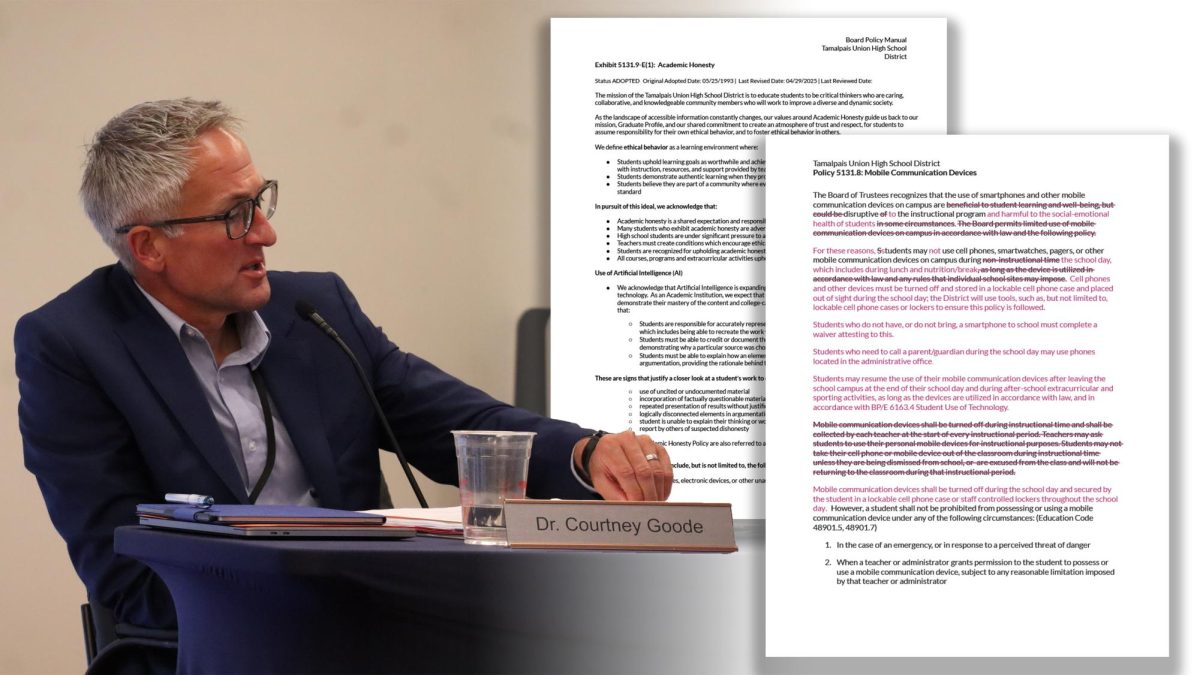
![Assistant Superintendent of Business and Operations Corbett Elsen presented an updated budget proposal for the 2026-27 fiscal year to the Tamalpais Union High School District (TUHSD) board of trustees on Tuesday, June 16.
Elsen presented an in-depth analysis of the district’s revenues, expenditures, future outlooks and the global and economic uncertainties affecting the district's revenue due to inflation and the war in Iran.
Because TUHSD is a basic-aid district, Elsen explained the significance of the housing market, stressing the gravity of the district’s financial situation as a result of lower demand.
“This is the bread and butter of our revenue: property tax revenues, [projected] to bring in over $93 million,” Elsen said, adding, “But ... we have decreased our revenue growth rate [projections].”
Elsen will return to the board of trustees on June 23, where the board will take formal action to adopt the proposed budget. To learn more about the updated budget proposal from the meeting, visit the June 16 TUHSD Gamut Online agenda.](https://redwoodbark.org/wp-content/uploads/2026/06/snapshot-1200x675.png)