
The decision of how to set up a classroom may often be overlooked. For teachers, it’s something they spend time debating. How should the desks be maneuvered just right? Room set-up can impact learning and interaction between students, and it’s what shapes the classroom environment.
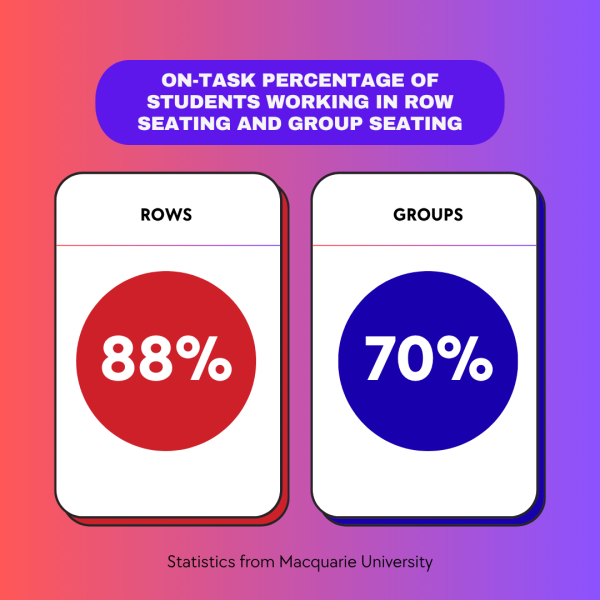
The idea of sitting in pairs has been proven successful. According to a 2013 study conducted by Macquarie University, students stayed on task 88 percent of the time when in rows, compared to staying on task 70 percent of the time when in groups.
Alex Franklin, an English 1-2 and Humanities teacher, recently rearranged his classroom into row seating, whereas he’s previously used horseshoe groups of five seating arrangements.
“What I found [works] best for me was rows and the interactive level of two people, as opposed to four or five,” Franklin said. “The way that I would sum that up is that it’s easier for me to move from order to chaos than from chaos to order. Sometimes, it was difficult to get to order quickly enough with the group setting.”
A case study conducted by Vanderbilt University found that group seating leads to increases in social interaction whereas row seating boosts on-task time and the amount of work done by students. Another study in 1987 by Wheldall and Lam found that the disruption rate when studying was three times higher in table clusters than in rows.
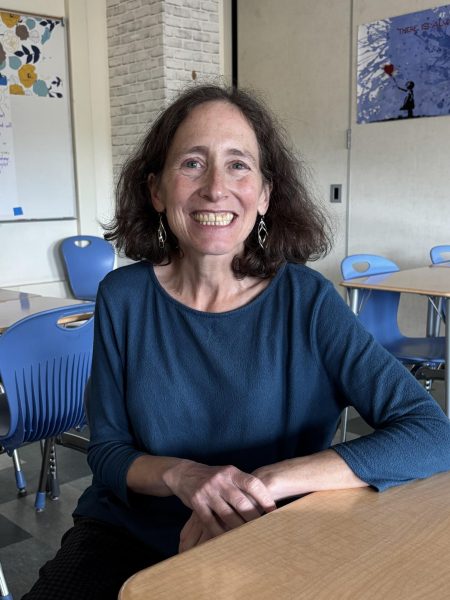
Donna Rabin, a English 3-4 and Advanced Placement Literature and Composition teacher, opted to arrange the desks in her classroom into groups this semester. Rabin had previously arranged them into a large horseshoe shape, but wanted to try something new.
“It gets so complicated trying to figure out the groupings because sometimes there are students who are friends who genuinely work really well together so you don’t want to just needlessly break people up and make people uncomfortable but as a teacher, you also want students to be productive,” Rabin said. “[Group seating can have] disadvantages. If I present things at the front [of the classroom], it gets awkward for people to see, and there can be distractions.”
Rabin debates whether or not to utilize rows of desks, with one student at a table or group seating, with various distractions coming with groups.
“Inevitably, there are groups that do work really well together. There are also groups where you can see pretty quickly that there’s tension and conflict or there’s one person who is pulling all the weight, and that gets really annoying for that person and there are people who are just slacking off,” Rabin said. “I feel like the only way to manage those issues with groups is to change things up [by moving people around] every few weeks.”
Liana Frankos, a psychologist intern at Redwood, focuses on the assessment of special education services as well as behavior and academic interventions in order to enhance student performance.
“Teamwork and collaboration is more important [than individual work with more focus] because you can always have new strategies to monitor yourself and redirect your focus onto the task, but it’s different than gaining the skills to work in groups,” Frankos said. “These skills will carry on with you to college or in your job field.”
Communication and critical thinking skills grow, especially in teenage years, and it’s increasingly important for those skills to be growing in school.
“There are cons for groups though, you can get very off task, especially if you’re paired with your friends,” Frankos said. “I also think an additional con with rows is that you don’t get as much collaboration with your peers…sometimes quiet people prefer to work alone, but they also might not have that social capacity to initiate those conversations in groups. There are two sides to every coin.”
Both rows and groups can pose their own problems such as lack of emotional connection with peers in rows, and too much chatter in groups. It dials down to different types of people and their personalities.
“From the teacher’s perspective, especially because I’m new this year, you always have the feeling that everybody in the class knows each other and you’re the only one who doesn’t, but the reality is [the students] don’t know each other at all,” Rabin said.