
Since 1911, racially restrictive covenants have been in place in Marin County. Racially restrictive covenants are discriminatory sections that are inserted into property deeds to prevent people of color from owning, renting or occupying land in specific white neighborhoods.
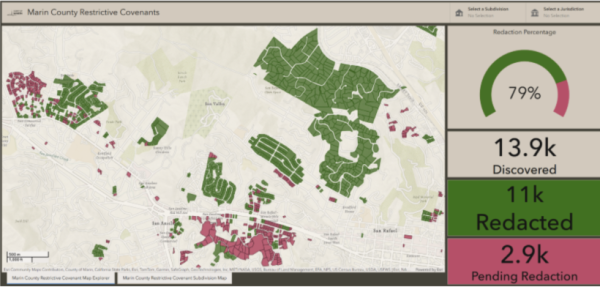
Although these restrictive covenants remain an issue in Marin, the Marin Restrictive Covenant project is leading an initiative to identify these old covenants in property records and legally modify these restrictions to show they are void. The Restrictive Covenant Project has found about 5,700 documents with illegal restrictions in Marin County.
Emilee Bozzard is a current supervisor of the recorder’s office who has been working with the Restrictive Covenants Project for five years. She explained that the identification process depends on the parts of Marin that were being developed prior to the 1970s, as well as knowing which lands were subdivided into non-white and white neighborhoods.
“The first part of our process was to go through conditions, covenants and restrictions, which usually cover a whole subdivision,” Bozzard said.
Bozzard said that in the early 1900s, Marin was just getting settled as a county after it was founded in 1850, and restrictive covenants weren’t a top priority or top-of-mind issue. This often led to second-generation Marin residents inheriting their family’s homes, which then often prevented people of color from living in those subdivided Marin neighborhoods.

However, Bozzard also mentioned that, more recently, homeowners around Marin have come into the recorder’s office to get restrictions removed from their homeowner deed.
“We do have homeowners come in and ask about [restrictions] and want to get them off of their deed. Supporting the modifications, nobody’s been against that, but [residents are] against the restrictions being in their [deed] in the first place,” Bozzard said.
Life science teacher Jonathan Hirsch said that segregation was apparent in communities around Marin. For minorities, the opportunities for higher education and job experiences were almost nonexistent, and as a result, the living conditions were poor for minorities.
“At first, largely by necessity, because there were very few educational opportunities for Black people, the opportunities to make a lot of money and earn a high income were low, and so they tended to move into these low-income areas and tended to group together for safety,” Hirsch said.
Hirsch said the historical restrictions in place at the time shut out anyone who wasn’t white, creating a feeling that “Only white people were allowed to live in Marin.”
In 1933, President Franklin D. Roosevelt was trying to make it easier for Americans, regardless of race, to own homes. He created two organizations, the Home Owners’ Loan Corporation (HOLC) in 1933 and the Federal Housing Administration (FHA) in 1934. Both made homeownership more accessible for Americans, but the FHA was discriminatory towards minorities.
Hirsch described how citizens often questioned the process of how loans to assist in the purchasing of homes were given. One question that arose was how loans were going to get repaid and how much banks would be willing to loan.
Later in the 1930s, Roosevelt created redlining maps that predicted in which areas people were more likely to pay their loans back. Hirsch explained that the maps turned out to be racially divisive.
“Segregation created a system where Black people and white people barely knew each other or talked to each other, or had any experience with each other,” Hirsch said.
Hirsch said that there were cases where minorities would move into white neighborhoods and experience racial attacks, especially if a minority lived alone.
“[There was] this idea that if a Black family moves in, it’s going to ruin the neighborhood,” Hirsch said.
The Marin Restrictive Covenant Project created a redlining map to show which neighborhoods were segregated. Bozzard said that they provided the data for the maps, which made it clear to see what parts of Marin were affected by restrictive covenants.
“We wanted to show what parts of Marin were affected, and that was a whole [new] layer of this project: not only finding the documents [and] creating modifications, but then finding out what land this affects,” Bozzard said.
Bozzard said that she thought the best way for communities to make amends in originally segregated areas is to be aware that it happened and not make presumptions.
“Acknowledging that it’s an issue is definitely the first step, because we just have assumptions that we’re not [racist] here,” said Bozzard.