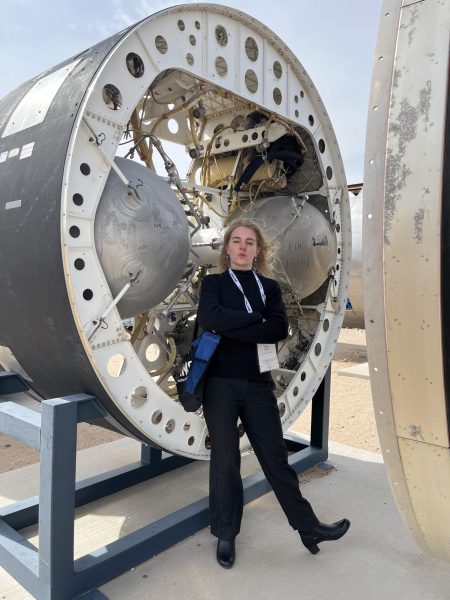
Women make up only about 32 percent of jobs in the nuclear power workforce, according to the US Department of Energy. Junior Lillian Merrill is already orienting herself towards that field.
“I was always really into science and physics as a kid,” Merrill said. “In sixth grade, I did a project where I studied the Doppler effect and red shift, and that got me on a physics kick.”
In eighth grade, she participated in her school’s “Innovation Convention” where students built windmills. Merrill told her mother about the project, and her mother responded with something that stuck with her.
“She said, ‘if we don’t get fusion, we’re screwed,’” Merrill said.
Fusion is the process of two atomic nuclei combining to form a nucleus. Scientists are trying to recreate it on Earth to produce nearly inexhaustible energy.
“A lot of the energy resources we were studying— coal, gas, petroleum, and then wind energy— can be good, but they’re not great,” Merrill said. “They’re not going to be what helps us achieve our climate and energy goals with fast growing technologies, our growing population and growing interest in sustainability.”
From that point, Merrill began to conduct research, starting with the history of nuclear energy. She looked into disasters such as the 1986 Chernobyl Nuclear Power Plant explosion in Ukraine—formerly a part of the Soviet Union—and the nuclear explosion at the Fukushima Daiichi Nuclear Power Plant in 2011. What she found was that the key causes of these explosions weren’t due to nuclear radiation, but instead human error.
“A lot of what took place [at Chernobyl] was due to poor regulation and poor design of the reactor that they were using, as well as the cover-up behind it,” Merrill said. “I realized while these disasters were awful, they cannot be compared to the damage that is caused by the fossil fuel industry and coal energy production, and so really nuclear [energy] is the solution.”
She compared energy sources by their output, carbon dioxide production, cost and human safety to understand what the best source was.
“There’s no way to articulate, other than looking at the numbers, how safe nuclear energy is and how sustainable it is, in comparison to what we’re utilizing the most in our energy infrastructure,” she said.
Merrill also enrolled in an online course through Massachusetts Institute of Technology, where she studied nuclear energy, fusion, fission and quantum mechanics.
“That course was really what solidified my interest [in nuclear studies],” Merrill said.
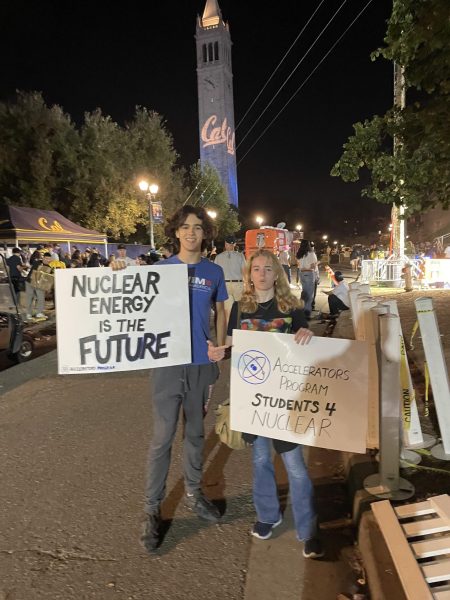
Merrill co-founded Nuclear Club in fall 2024 alongside current junior Rex Reidel to educate members, while also organizing speakers, activities and field trips for participants. Reidel first met Merrill in eighth grade, where they shared a love for science.
“She’s very determined and works hard to achieve her goals,” Reidel said. “Her abilities and persistence in the field are very admirable.”
Then just two years later, they co-founded Nuclear Club.
“We started [Nuclear Club] as a forum to discuss and explore our interest in the field,” Reidel said.
A highlight for the club was when Gamma Reality, a Berkeley-based radiation-detection company, visited Redwood, bringing their Boston Dynamics robot dog with sensors and light dection and radiation (LiDAR) technology.
“I think it showed the people there, as well as it showed me, how nuclear science can be applied,” Merrill said. “It’s not just energy and weapon production, there’s detection and cyber security, which is what this device is primarily used for.”
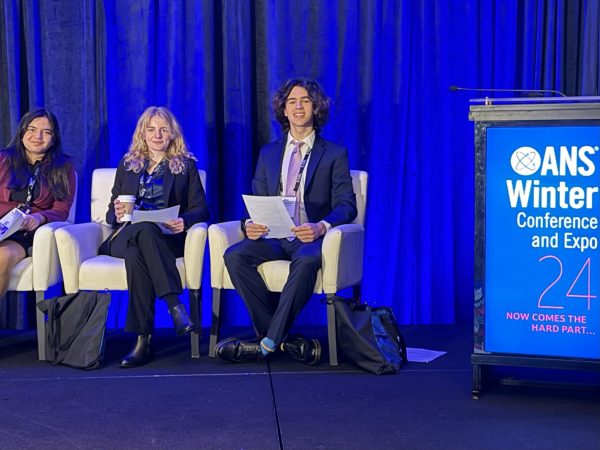
To continue her advocacy outside the classroom walls, in November 2024, Merrill attended the American Nuclear Society’s Winter Conference and Expo. There, she spoke on an education panel, pushing for easier access to nuclear study opportunities for students.
“We really preached that the nuclear field needs to be more open to younger age groups, because it’s really restricted,” Merrill said. “A lot of the internships that are available are 18-years-old and older or for undergraduates, and the number of actual high school internships are very scarce and location limited.”
In the future, Merrill hopes to continue exploring nuclear science, potentially pursuing nuclear forensics.
“I really don’t know what I want to get into specifically with nuclear science, because it’s all so interesting to me,” Merrill said. “What I really want to do is focus on getting more experience in the field and working in reactors, with labs and really just taking up any opportunity I can get.”