
On July 1, a Marin County law took effect, banning anyone under the age of 16 from operating class two electric bikes (e-bikes). Recently, this law has been reshaping how students get around. Students who had previously ridden a class two e-bike now struggle to travel around town and to school.
The enforcement of this law makes Marin the first county in California to set an age restriction on class two e-bikes. In California, these e-bikes are classified as having a motor that boosts riders up to 20 miles per hour and can be operated using a throttle or pedal-assist. The measure also strengthens helmet requirements for all riders.
Currently, Corte Madera police are cracking down on teens riding e-bikes on streets surrounding school, now ticketing youth. An anonymous sophomore, who will be referred to as “Joe,” was pulled over on Doherty Drive, a street adjacent to school, and given a fine.
“I was heading to school from the gas station [on the corner of Magnolia and Doherty] when I passed by the police station. It caught an officer’s attention,” Joe said.
Joe was given a warning ticket along with a $25 fine, and told to not ride his illegal e-bike anymore.
“Because I’m not 16 yet, getting to school and getting around with friends will be more difficult now that I’m not able to ride my bike,” Joe said

Teachers and parents have mixed feelings when it comes to the implementation of this law. While some are relieved by the removal of these fast throttle powered bikes, others worry that it will give students a harder time getting to school and around independently.
Advanced Placement (AP) World History and Life Lab teacher Michelle Ceja-Chau has noticed students riding e-bikes for some time and overall believes they may be more positive than negative.
“There were so many other steps that could be taken before a total ban [of e-bikes],” Ceja-Chau said. “I don’t think [the law] should just take away this method of transportation without offering an alternative.”
Ceja-Chau also advocates that e-bikes are not only important for transportation to school, but also in order to be social with friends outside of school. She recalled one interaction with a student whom she talked to about e-bikes.
“Before he had his e-bike, he wasn’t going out and wasn’t very social. But with his e-bike, he was able to be more active and establish a community, which also led to a positive change in his mental health,” Ceja-Chau said.
To address the issue in a more balanced way, Ceja-Chau offered an alternative solution.
“Because Marin is a biking community, safer routes, such as bike paths, would be a more positive alternative to a complete ban,” Ceja-Chau said.
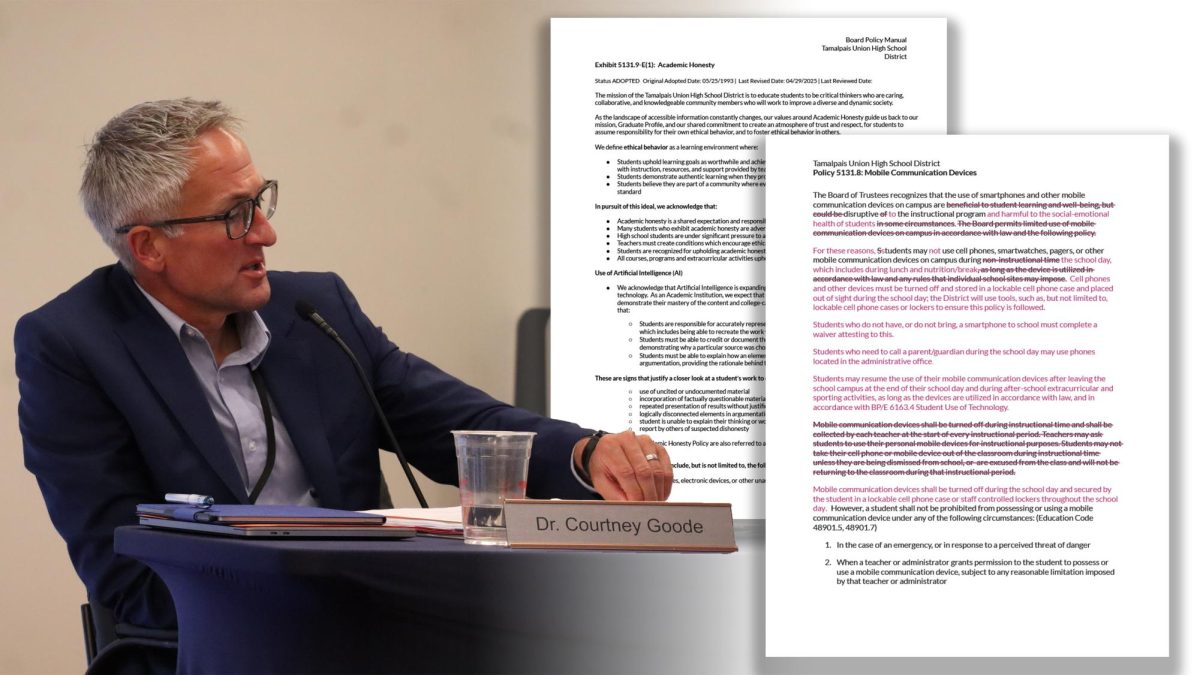
![Assistant Superintendent of Business and Operations Corbett Elsen presented an updated budget proposal for the 2026-27 fiscal year to the Tamalpais Union High School District (TUHSD) board of trustees on Tuesday, June 16.
Elsen presented an in-depth analysis of the district’s revenues, expenditures, future outlooks and the global and economic uncertainties affecting the district's revenue due to inflation and the war in Iran.
Because TUHSD is a basic-aid district, Elsen explained the significance of the housing market, stressing the gravity of the district’s financial situation as a result of lower demand.
“This is the bread and butter of our revenue: property tax revenues, [projected] to bring in over $93 million,” Elsen said, adding, “But ... we have decreased our revenue growth rate [projections].”
Elsen will return to the board of trustees on June 23, where the board will take formal action to adopt the proposed budget. To learn more about the updated budget proposal from the meeting, visit the June 16 TUHSD Gamut Online agenda.](https://redwoodbark.org/wp-content/uploads/2026/06/snapshot-1200x675.png)