The Student-Led Anti-Racist Movement (SLAM) club’s first meeting on Tuesday, Oct. 28 drew six attendees after SLAM was discontinued as a class at the beginning of this school year. Despite this, the club leaders are still striving to educate students about racism by having challenging conversations about topics such as race and how to be aware of implicit bias.
Due to a lack of sign-ups this year, David Minhondo, Life Lab, United States History and Film teacher, had his SLAM class removed from the course list. According to Minhondo, this lack of involvement stemmed from several reasons.
SLAM was a popular class in 2020, then going into its second year. Minhondo speculates that George Floyd’s murder and the protests that followed sparked interest in racial issues amongst students, as there were 75 sign-ups.
Juxtaposed against the enthusiasm and protests that year, that same interest appears to be dwindling.
“[Racism seems to be] less prevalent in students’ minds. In our schools, the vast majority [of students] are white, so discussing race can be an uncomfortable topic,” Minhondo said. “Signing up for a class where they know they’re going to be uncomfortable is not something that a lot of students want to do.”

Principal Dr. Barnaby Payne shared another reason the course was removed.
“When SLAM started at Redwood, there were no other versions of ethnic studies at our school. Now, every ninth grader takes the Community and Consciousness course, which has ethnic studies and elements of identity-centered education,” Dr. Payne said.
Despite the end of SLAM as a course, its mission for equality is still alive in the SLAM club. Senior club presidents Isabel Kletz and Siena Ledesma believe SLAM’s message is especially important today in Marin.
“[Privilege] is so important for people in Marin to understand, especially because so many of my peers who see the Stop and Learns think, ‘this is stupid. I already know this.’ But personally, [many of] the students that I know who are white are not going to understand the effects that racism has on other people,” Ledesma said. “Having that awareness is so important, and I don’t think that’s being spread to the students here.”
Kletz shared another reason why SLAM is important to Marin.
“Hearing from people with all different backgrounds is important to [create] a community, and a diverse community is really important. Marin definitely lacks that connection. It’s just really frustrating, [because sometimes it feels like] the school prioritizes Tobacco Use Prevention Education (TUPE) and Peer Resource over SLAM,” Kletz said.
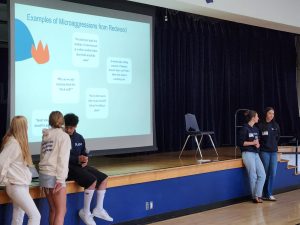
SLAM was previously a project-based course, where students chose what they wanted to learn. Last year, projects included promoting local Black-owned businesses, making Redwood TV segments, touring San Quentin and presenting at Del Mar and Hall middle schools. Many of their projects were intended to continue this school year; however, club members noticed less support from the school after the class was dropped.
“When they cut our class, we were all hoping that it wouldn’t be significantly diminished, but now we see that [SLAM] is getting washed away and pushed under the rug,” Kletz said.
Regardless of the decreased support from the school, the SLAM club is able to provide members with opportunities for introspection, personal growth and exploration through small group discussions, projects and presentations.
“[During club meetings,] we all sit in a circle to discuss, and it isn’t like Mr. Minhondo is talking down to us. It is very equal and makes me feel heard and part of a community. [SLAM] teaches me to be honest and how to articulate myself in a high-stress environment, which is important overall,” Kletz said.
The SLAM club also helps members broaden their interests.
“[SLAM] has helped me find passions, such as criminal justice, that I wouldn’t have ever expected [to find] without [it],” Ledesma said.
The club has plans to present to Del Mar students this year, and interested students at Redwood can attend club meetings on Tuesdays at lunch in room 707.