For decades, late-night television shows have been a significant platform for political satire and comedy, with comedians frequently poking fun at politicians and using humor to shed light on current events. But recent controversies involving late-night hosts Jimmy Kimmel and Stephen Colbert have ignited a debate over the right to free speech under the First Amendment, as the conversation on whether it protects entertainment as well is ignited.
“Jimmy Kimmel Live!” was suspended by the American Broadcasting Company (ABC) on September 17, 2025, after Kimmel referenced conservative activist Charlie Kirk’s assassination in his nightly monologue, prompting questioning reactions from Trump supporters.
Federal Communications Commission (FCC) Chairman Brendan Carr condemned Kimmel’s comments and signaled to ABC that they would take prompt action against them, unless Kimmel was pulled off the air. ABC’s parent company, Disney, suspended Kimmel in response, but later reinstated him following mass protests. Disney underwent criticism from politicians who called it censorship, celebrities who
threatened to break ties with Disney and users who cancelled their Disney+ subscriptions, ultimately causing Disney’s stock price to rapidly decline. Between the suspension and being reinstated, The Guardian listed Disney’s loss in market value to be approximately $4 billion.

(Photo Courtesy: Steve Rhodes – Flickr).
In the wake of the Kimmel and Colbert controversies, many have expressed their concerns as to how this could impact free speech in the United States.
Redwood Television advisor, Teachers’ Union President and drama teacher Erik Berkowitz raised concerns.
“Personally, I think we’re living in a dangerous time when corporations are making decisions about someone’s free speech based on guidance from public officials,” Berkowitz said.
World History teacher Corin Greenberg pointed out historical examples of restricting the media.
“I know any time we study governments that are trying to take more power or be more authoritarian, the one thing they always crack down on is entertainment in the media. [The governments] try to make sure the media is expressing the ideas they want them to express,” Greenberg said. In contrast, some conservative-leaning activists were unhappy with Kimmel’s return. The executive producer of “The Charlie Kirk Show,” Andrew Kolvet, expressed his frustration about the situation through a post on X.
“Disney and ABC caving and allowing Kimmel back on the air is not surprising, but it’s their mistake to make. Nexstar and Sinclair do not have to make the same choice,” Kolvet said, referring to local broadcast companies that chose not to air Kimmel’s return to late-night TV.
Kimmel’s show has a wide audience that reaches many different Americans, especially the youth. Students have followed late-night talk shows closely for years now and have gained a strong understanding of politics because of this. Junior Jonah Kizer defended the importance of the protection of free speech in the media.
“I think the shows are very important, in the way they impact our young generations and how our society is built on different people sharing their own views,” Kizer said. “We have a very diverse and very integrated society that’s beautiful because we all can share our own ideas and not have to fear that it’s going to get taken down.”
Similarly to Kimmel, Columbia Broadcasting System (CBS) announced earlier this year that “The Late Show with Stephen Colbert” would be cancelled next year, in a decision that was announced after Colbert criticized a $16 million deal between Paramount Global (CBS’s parent company) and President Donald Trump settling a lawsuit over a “60 Minutes” interview with former Vice President Kamala Harris. Despite this, CBS cited financial reasons for the cut of “The Late Show.”
In response to the removal of Kimmel and Colbert, some Americans have expressed concern about where the attempts to silence certain voices could be leading.
“I think we’re at a time, unfortunately, where people are picking and choosing who can say what, and who can’t say what. It seems like people are picking sides, and people don’t want to hear [other perspectives] that disagree with them,” Berkowitz said.
When Kimmel returned to his show on September 23, following his suspension, Kimmel thanked his supporters for advocating on his behalf. Additionally, Kimmel stressed the importance of upholding free speech in the United States.
“This show is not important. What is important is that we get to live in a country that allows us to have a show like this,” Kimmel said.
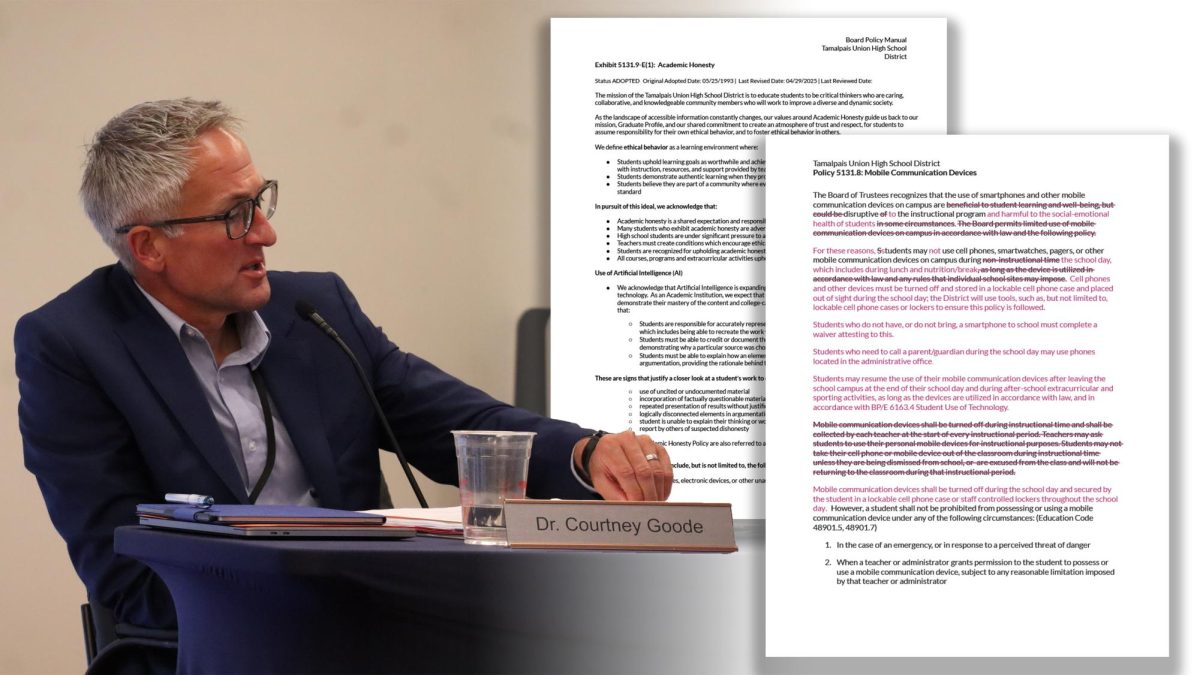
![Assistant Superintendent of Business and Operations Corbett Elsen presented an updated budget proposal for the 2026-27 fiscal year to the Tamalpais Union High School District (TUHSD) board of trustees on Tuesday, June 16.
Elsen presented an in-depth analysis of the district’s revenues, expenditures, future outlooks and the global and economic uncertainties affecting the district's revenue due to inflation and the war in Iran.
Because TUHSD is a basic-aid district, Elsen explained the significance of the housing market, stressing the gravity of the district’s financial situation as a result of lower demand.
“This is the bread and butter of our revenue: property tax revenues, [projected] to bring in over $93 million,” Elsen said, adding, “But ... we have decreased our revenue growth rate [projections].”
Elsen will return to the board of trustees on June 23, where the board will take formal action to adopt the proposed budget. To learn more about the updated budget proposal from the meeting, visit the June 16 TUHSD Gamut Online agenda.](https://redwoodbark.org/wp-content/uploads/2026/06/snapshot-1200x675.png)