Before a teacher finishes grading an essay or writing a new assignment, a small Google Chrome extension may already be helping behind the scenes to assist teachers produce results. Across campus, teachers have been experimenting with Brisk Teaching, an artificial intelligence (AI) platform designed specifically for educators. According to Brisk Teaching, “[Brisk] personalizes learning materials, generates feedback and adapts to student needs—right inside the Google and Microsoft tools [educators] already use.”
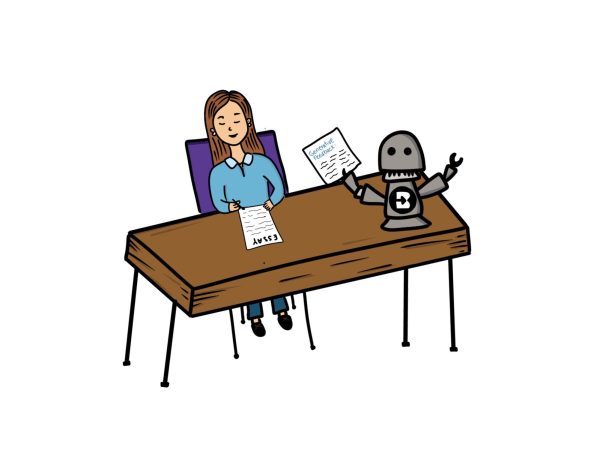
As artificial intelligence becomes increasingly common in everyday technology, classrooms are beginning to feel its influence as well. Tools such as Brisk are prompting conversations about how AI can support teaching while raising questions about fairness, responsibility and what is the appropriate use of technology in schools.
World History and Advanced Placement (AP) African American Studies teacher Nikolai Butkevich first became interested in artificial intelligence after hearing about ChatGPT in late 2022.
“I remember just completely freaking out and thinking that my entire profession was about to get nuked,” Butkevich said.
Instead of avoiding the new technology, Butkevich began experimenting with it. For months, he searched for AI platforms with the intention of giving quicker, more useful feedback on student work; something that he said had always been difficult to manage with limited time.
“I was looking for a platform that could give feedback to student work in a way that was accurate, quick and would actually be helpful to students,” Butkevich said. “Everything that was available was terrible.”
Eventually, he came across Brisk, a platform developed largely by former teachers and designed with K-12 classrooms in mind. After testing the tool himself, Butkevich began sharing its impact with other teachers.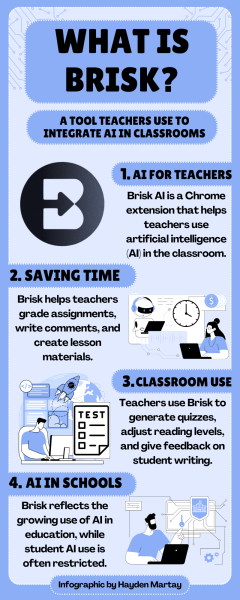
“I just asked for 15 minutes at the end of a staff meeting to show what I was using,” Butkevich said. “[The tool] got taken up.”
Butkevich said one of the most useful features Brisk offers for his teaching is the ability to translate assignments and materials for students learning English.
“In the past, it took forever to prepare translations,” Butkevich said. “Now, it’s really easy. With Brisk, I can translate what I’m giving the class into Spanish or Chinese almost instantly.”
According to Butkevich, this allows students who are still learning English to participate more in classroom activities.
“That [translation feature] for those students, who historically have been very badly served because teachers just didn’t have the time, is revolutionary for them,” Butkevich said.
After Butkevich introduced the platform in Spring 2025, interest spread quickly among teachers curious about how artificial intelligence might support their work.
AP World History and American Government teacher David Plescia says he occasionally uses AI tools like Brisk when generating discussion questions or modifying assignments.
“I would maybe say 15 to 20 percent of my assignments involved [Brisk] in some way last year,” Plescia said.
According to Plescia, AI can help teachers brainstorm ideas quickly, especially when creating questions or prompts that teachers can refine.
“I can ask [Brisk] for 10 different critical thinking questions about a document and then choose the ones I like,” Plescia said. “It’s a great tool because of how efficient it is.”
However, he noted that AI-generated material still needs careful review.
“It’s trial and error,” Plescia said. “You still have to rework things.”
English 3-4 and Humanities/Short Story teacher Kendall DeAndereis uses Brisk in a different way. She uses it primarily to help monitor student writing and prepare students for standardized tests.
“One of the tools that Brisk has that I use is called ‘Inspect Writing,’” DeAndereis said. “[Teachers] can see students’ keystrokes and if they paste large chunks into their text. We can see their editing progress and timestamps. That’s really useful if we’re suspicious of students [not] doing their own work.”
She additionally utilizes Brisk to generate comprehension questions that mirror the format of the California Assessment of Student Performance and Progress (CAASPP) test. This helps save her lots of time.
“Brisk [generates questions] in a matter of seconds. It has allowed me quick ways to implement CAASPP prep for my students without spending [too much] time away from our regular curriculum,” DeAndereis said.
DeAndereis sometimes uses the platform to modify reading levels of texts to support students who may not be reading at grade level.
“I’ve used it to take an article we’re reading and lower the reading level to seventh or eighth grade,” DeAndereis said. “It makes [the article] more approachable for them.”
When asked if AI should be integrated into more parts of student learning, she touched on the importance of students developing their own critical thinking skills.
“I want students to engage in productive struggle,” DeAndereis said. “Students often feel vulnerable when they don’t know what to think or how to do something, and instead of dwelling in that space of struggle, they’re quick to use AI to jump out of it. I think that’s really detrimental to their critical thinking skills.”
She also expressed concerns about teachers relying too heavily on AI to provide feedback to students.
“I’ve seen feedback provided by AI that doesn’t take into account the whole student,” DeAndereis said. “Teachers know more than what meets the eye when it comes to student work. We’re able to tailor our feedback in ways that a computer who doesn’t know our student can’t.”
The growing presence of AI tools in classrooms reflects a broader national trend. According to a 2025 Gallup article and survey, “Teachers who use AI tools at least weekly estimate they save 5.9 hours per week, on average. Over the course of a 37.4-week school year, these time savings add up to the equivalent of six weeks per school year.” Research from the Associated Press in an article titled, “How ChatGPT and other AI tools are changing the teaching profession,” found that, “about eight in 10 teachers who use AI tools say it saves them time on work tasks like making worksheets, assessments, quizzes or on administrative work. And about six in 10 teachers who use AI tools said they are improving the quality of their work when it comes to modifying student materials, or giving student feedback.”
Back in classrooms, students are beginning to see how these tools are shaping their own learning experiences..
Junior Dylan McDonald said he first experienced using Brisk in his AP U.S. History class.
McDonald said he trusted teachers’ feedback more than AI-generated responses.
“I feel like I trust [my teacher] to grade an assignment more than I trust an AI to grade it,” McDonald said. “I just don’t think AI is perfect yet.”
As artificial intelligence becomes more common in classrooms across the country, schools are still trying to figure out how the technology should fit into teaching and learning. While tools like Brisk can help educators save time and adapt material, other teachers remain cautious about relying on this new tool. For students like McDonald, interacting with AI in the classroom is still new, and many continue to place greater trust in feedback from their teachers. As both teachers and students experiment with Brisk, the conversations unfolding in classrooms reflect a broader shift in education: how artificial intelligence can support learning while continuing to preserve human guidance at the center of the classroom.