

On Feb. 12, the Environmental Protection Agency (EPA) repealed the 2009 Greenhouse Gas Endangerment Finding, a science-based conclusion issued under the Obama administration. The original finding determined that greenhouse gases, such as carbon dioxide and methane, harm public health due to their contributions to climate change.
Under the Trump Administration and EPA administrator Lee Zeldin, the Endangerment Finding no longer allows the government to regulate greenhouse gas emissions through the Clean Air Act.
According to the EPA, “In this final rule, EPA is saving American taxpayers over $1.3 trillion, eliminating both the Obama-era 2009 Greenhouse Gas (GHG) Endangerment Finding and all subsequent federal GHG emission standards for all vehicles and engines of model years 2012 to 2027 and beyond.”
While the EPA has described the repeal as a cost-saving incentive, Advanced Placement Environmental Science (APES) teacher Mitch Cohen finds it to be economically motivated.
“I think that the denial is really based on political and economic gain; they’re not looking at it from a scientific perspective,” Cohen said. “They’re looking at it from an economic perspective and more importantly, what’s best for the short-term economic interest of a very limited number of companies.”
Chance Cutrano, the Director of Programs at the Resource Renewal Institute, oversees the organization’s environmental programs and advocates for the mitigation of climate change.
“Science doesn’t change just because a couple of people decide that a policy changes or a rule changes,” Cutrano said. “The evidence continues to mount that greenhouse gases have a direct harm on human health and ecosystems, and that’s only grown stronger since the endangerment finding was created in 2009.”
Additionally, Cohen believes that the scientific evidence backing the 2009 finding is overwhelming and that the increased emissions of greenhouse gases into the atmosphere are linked to the rise of natural disasters.
“If you look at these extreme weather events that we’ve been having, there are things like increased fires, increased floods and increased hurricanes. All of those unequivocally threaten both human property and human safety,” Cohen said.
Junior Riya Pyle, a Sustainable Agriculture and APES student, hopes that the repeal will motivate the environmental scientists to continue finding data to back their claim.
“I felt more sad for all the people who’ve worked so hard for these findings that have just been taken away,” Pyle said.
The repeal of the Greenhouse Gas Endangerment Finding will have widespread effects on how the United States uses the government to regulate greenhouse gas emissions. As of right now, the long-term effects are uncertain, but the beliefs of environmental experts like Cohen and Cutrano conclude that the evidence supporting the finding is overwhelming.

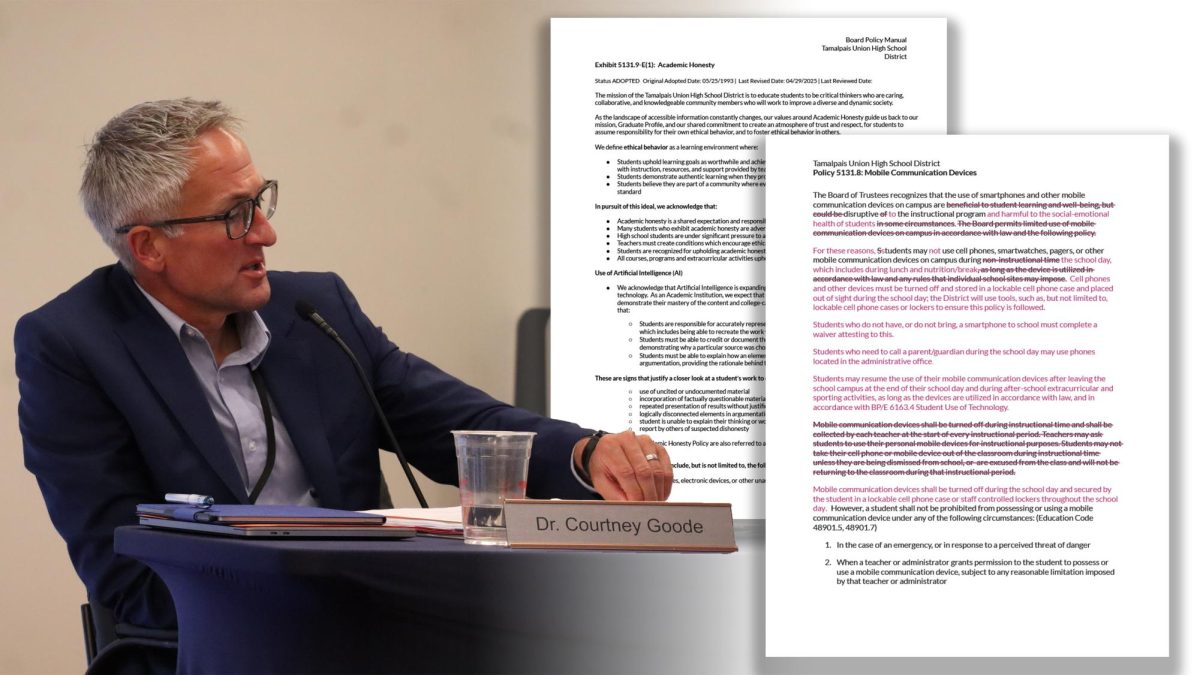
![Assistant Superintendent of Business and Operations Corbett Elsen presented an updated budget proposal for the 2026-27 fiscal year to the Tamalpais Union High School District (TUHSD) board of trustees on Tuesday, June 16.
Elsen presented an in-depth analysis of the district’s revenues, expenditures, future outlooks and the global and economic uncertainties affecting the district's revenue due to inflation and the war in Iran.
Because TUHSD is a basic-aid district, Elsen explained the significance of the housing market, stressing the gravity of the district’s financial situation as a result of lower demand.
“This is the bread and butter of our revenue: property tax revenues, [projected] to bring in over $93 million,” Elsen said, adding, “But ... we have decreased our revenue growth rate [projections].”
Elsen will return to the board of trustees on June 23, where the board will take formal action to adopt the proposed budget. To learn more about the updated budget proposal from the meeting, visit the June 16 TUHSD Gamut Online agenda.](https://redwoodbark.org/wp-content/uploads/2026/06/snapshot-1200x675.png)