On Nov. 6, the 33rd Annual Food Drive began at Town Center Corte Madera with the renowned giant turkey and will be open for donations through Dec. 31.
The food drive began in 1992 and collects nonperishable food items for families in need around the holiday season. It is run through the San Francisco-Marin Food Bank, whose mission is to end hunger in San Francisco and Marin by making food accessible for everyone.
The most unique element of this food drive is the giant turkey statue they set up to draw attention to the cause. Senior Director of Community Engagement Katy Mann, who oversees the volunteering program at the SF-Marin Food Bank, reflected on this aspect of the food drive.
“The turkey [statue] allows for awareness building, and also a place for people to drop off food if they want a physical food donation,” Mann said. “We’re serving 36,000 households every single week across San Francisco and Marin, so our capacity to deliver barrels [and] pick up barrels is pretty limited. We’re really grateful that there’s the Town Center [to provide a place to donate].”
This kind of food stability is important for people to have right now due to the recent government shutdown, which lasted 43 days from Oct. 1 to Nov. 13. The shutdown impacted the Supplemental Nutrition Assistance Program (SNAP), which is a federally funded program that provides food benefits to low-income families. According to Pew Research, 41.7 million people received SNAP benefits in May of 2025, which means that the shutdown stopped millions of people from receiving food assistance for over 43 days.
“Now [with] the government shutdown, it’s become a lot more apparent how important those safety net services [like SNAP] really are for people because we’re not able to purely distribute food, we just don’t have the resources and the capacity. 125,000 households between San Francisco and Marin lost access to their benefits,” said Mann.
The SF-Marin Food Bank recognizes the demand for food, with 1 in 4 San Francisco residents and 1 in 3 Marin County residents not making enough money to have food security.
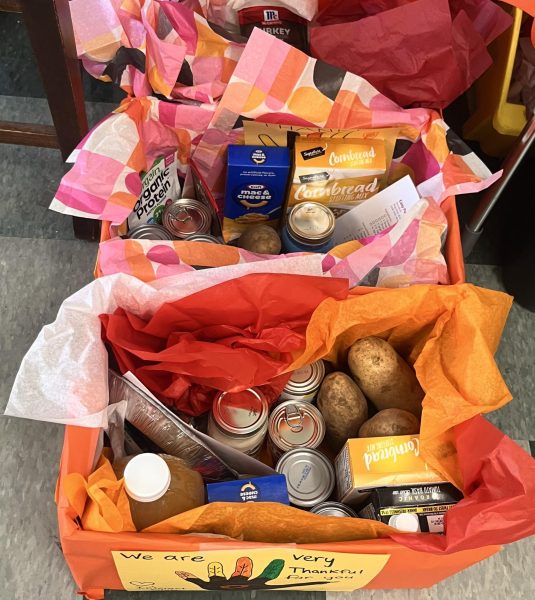
Mann explained how some of this demand has been met with individual food drives and donations run locally to support those in need. Similarly, the Interact Club participated in its second annual box food service this year.
The Interact Club is an international club run by Rotary, an organization that focuses on bringing community service to schools and the world as a whole. Math teacher Julie Norwood has been the club’s adviser for 10 years and sees the importance of supporting local families who struggle with food insecurity due to immigration issues in the United States.
“Not only is there a community dealing with food insecurity, but also dealing with immigration issues, and a lot of their parents can’t work now because they’re afraid of ICE [Immigration and Customs Enforcement],” Norwood said.
In the midst of this confusion with food instability and deportation fear, Mann explained how they have seen an increase in engagement and impact at the community level.
“Sometimes people feel [that] when the government is in chaos [and] when people are in chaos, they don’t know how to help and don’t know where to start. And what we’ve seen [in] the last six weeks [is] that people care a lot,” Mann said. “They might not have a lot to give, but they have a community, and they’re willing to stand up [for them].”
Similar to Mann, Norwood has seen the impact this support can offer and the importance in helping local communities in rough times for a broader population.
“They’re just struggling to get by day to day,” Norwood said. “So it’s just so important that they are given some aid when needed and given food in just a really tough time.”
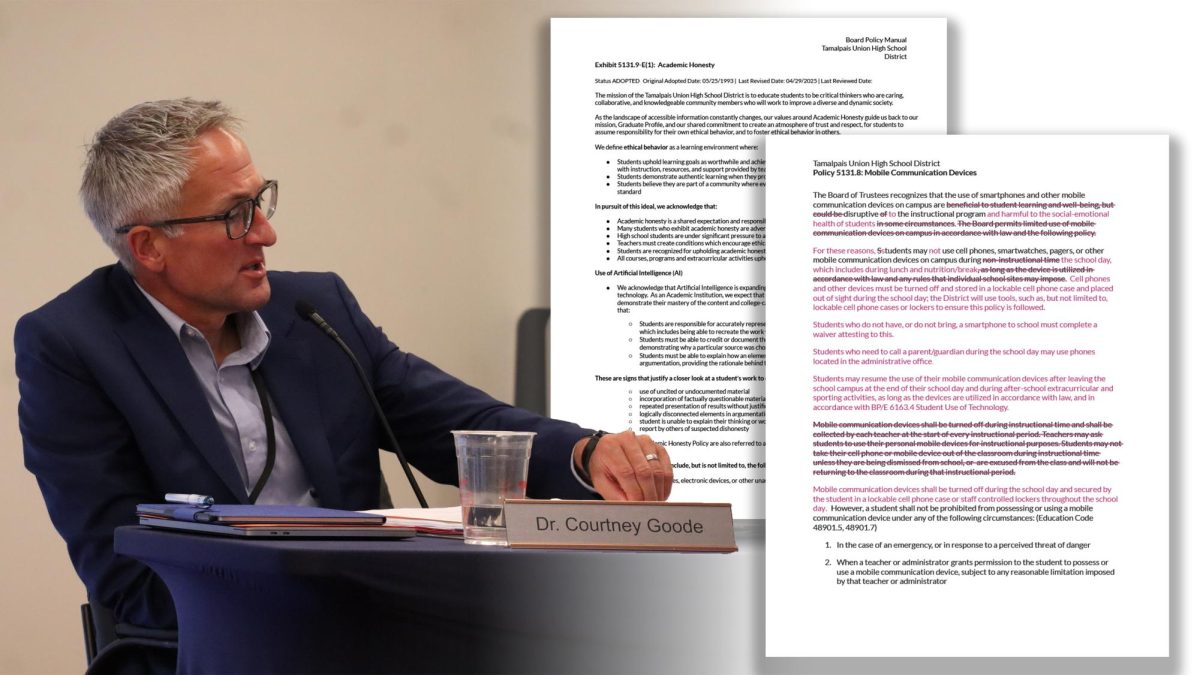
![Assistant Superintendent of Business and Operations Corbett Elsen presented an updated budget proposal for the 2026-27 fiscal year to the Tamalpais Union High School District (TUHSD) board of trustees on Tuesday, June 16.
Elsen presented an in-depth analysis of the district’s revenues, expenditures, future outlooks and the global and economic uncertainties affecting the district's revenue due to inflation and the war in Iran.
Because TUHSD is a basic-aid district, Elsen explained the significance of the housing market, stressing the gravity of the district’s financial situation as a result of lower demand.
“This is the bread and butter of our revenue: property tax revenues, [projected] to bring in over $93 million,” Elsen said, adding, “But ... we have decreased our revenue growth rate [projections].”
Elsen will return to the board of trustees on June 23, where the board will take formal action to adopt the proposed budget. To learn more about the updated budget proposal from the meeting, visit the June 16 TUHSD Gamut Online agenda.](https://redwoodbark.org/wp-content/uploads/2026/06/snapshot-1200x675.png)