In all California public schools, students – grades three through eight, as well as eleventh grade – are required to take the California Assessment of Student Performance and Progress (CAASPP) annually. Although the CAASPP test comes with long hours behind screens, endless passages and hundreds of numbers, it allows schools to gauge students’ skills in comparison to California state standards. This test is intended to keep public schools accountable for upholding students to these standards, as well as providing a way to rank schools based on academic performance.
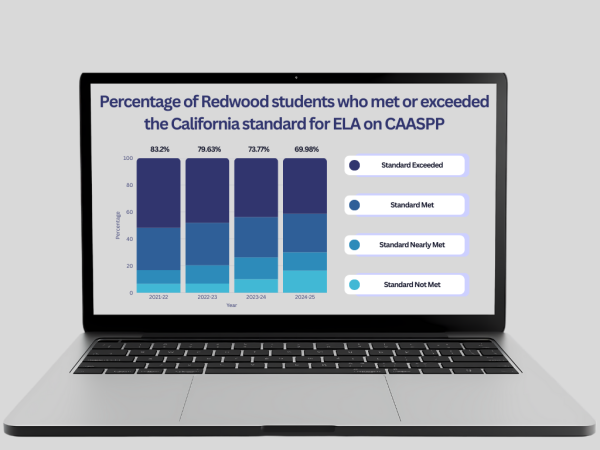
As a school that is ranked 50th out of 2,586 public high schools in the state, according to U.S. News & World Report, it is expected that Redwood would sufficiently meet and exceed standards. However, based on recent CAASP scores, this has been proven incorrect. In the 2022 to 2023 school year, Redwood’s percentage of students who met or exceeded state standards in the English and Language Arts (ELA) portion of the CAASPP test was 79.63 percent. In the 2024 to 2025 school year, the percentage of students who met or exceeded state standards was 69.98 percent.
This almost ten percent decrease prompts the question: Is Redwood’s academic curriculum failing to prepare students for this test, or do students not care enough to try?
At the district board meeting on Oct. 14, 2025, student representative for the Tamalpais Union High School District (TUHSD) Board of Trustees, Helen Kay, said, “Yes, unfortunately, students don’t necessarily feel that it has a big impact on how colleges are going to perceive them. Because the individual students’ scores don’t go directly to the colleges, a lot of students feel that they don’t need to do their best effort on the CAASPP tests.”
This disregard for the test raises concerns for teachers and school board members, who will be the ones receiving the backlash for the unexpectedly low scores. TUHSD board president Cynthia Roenisch spoke at the same board meeting and said, “We have 4 years of declining scores, where our comparing districts are holding steady or going up.”
The CAASPP scores are supposed to directly reflect the student body’s skills; when these scores drop, the perspective on the school changes as well. Kelly Lara, Assistant Superintendent of Educational Services at TUHSD, plays a crucial role in organizing and facilitating CAASPP testing on a yearly basis. This also includes ensuring preparedness and a sufficient curriculum amongst students.
“The CAASPP scores tell a story or have the potential to tell a story about rigor in our district to anyone who is looking at the data,” Lara said.
Senior Director of Curriculum and Instruction at TUHSD, Paula Berry, explained that administration and the school board are looking into implementing more tools in classrooms to help increase ELA scores specifically.
“One of the things we’re doing is trying to figure out how we can support teachers to share their expertise because we have a lot of incredible, talented teachers in our district,” Berry said. “[Teachers and staff] are working really hard to support students in their reading, their math, their writing and their literacy across the system.”
Specific actions have already been put in place in classes to help give teachers a better understanding of students’ skills and what can be improved. This includes common assessments administered on websites such as CommonLit, which provide accurate data on students’ academic skills to guide curriculum.
“One of the things that the teachers are doing in the classroom is developing common assessments together, as well as in the English classes,” Berry said. “That’s a newly adopted tool. What [common assessments are] allowing us to do is to get some baseline data so that when students come in as a sophomore and take that CommonLit assessment, the teacher can look at where they are entering into sophomore year, and can look at patterns and trends [as the student progresses through the school year].”
Using common assessments along with CAASPP testing scores, teachers from all subjects can communicate about this decrease in scores and strategize ways to improve the curriculum to better meet and exceed standards.
“TUHSD teacher leaders came together in math, English, social studies and science last year to do an analysis of our test scores and created a response plan. They implemented interim assessments from CAASPP in their classrooms so that students got practice with the CAASPP and the teachers received data on student performance,” Lara said.
However, the curriculum taught may not be the sole factor resulting in low scores. According to the California Department of Education, reading scores dropped from 51 percent to 47 percent, and math scores dropped from 40 percent to 33 percent statewide since the pandemic and the rise of Artificial Intelligence (AI).

However, although academic proficiency has stayed consistent at other schools, Redwood trails behind. English teacher Steve Hettleman has been teaching at Redwood for over 30 years and believes this drop shouldn’t be credited to the pandemic or new technology.
“COVID and AI are everywhere. So if this is Redwood, and these are our scores, and this is the state average, you would think that [these scores] would go down together, and so the gap would stay the same. What’s happening isn’t that. So that leads me to think it’s not something that’s happening to all kids. It’s the district,” Hettleman said.
This trails back to the idea that students lack understanding of the importance of the test, or maybe, lack care for the weight the test has on the school district.
“Maybe you have some students who don’t necessarily take it seriously, and so that’s dragging [the scores] down,” Hettleman said.
With that said, an improved curriculum may not be the end-all be-all solution to dropping scores, but rather the solution resides in improved motivation among students.
“I think it’s really important for students to understand [the importance of the test] and then to think about their score report as, ‘I want to be proud of that. I’ve worked so hard at Redwood to achieve grades and to do all the things my teachers are asking of me,’” Berry said. “[Students should be] showing up to do their best and be giving all their effort [to the CAASPP test], and we hope that they are prepared to be able to do that.”