
On Nov. 4, 2025, California voters will decide the fate of Proposition 50, a state-wide redistricting measure that plans to temporarily change the congressional maps of California in response to the newly redrawn congressional districts of Texas.
Advanced Placement U.S. History and Government teacher Lindsey Kornfeld was able to share her knowledge on the process of getting a proposition, such as Prop. 50, passed to the California legislature in comparison to other states.
“California actually has one of the lowest barriers in order for the populace to get a proposition put onto the ballot,” Kornfeld said.
Prop. 50 is a constitutional amendment and will be on the upcoming California special election ballot. If passed, Prop. 50 will allow for provisional changes to the California congressional districts through the year 2030.
“A proposition is going to have the power of law, but be decided on by the people, so instead of our representatives deciding on our districts, the people are going to decide on if they like them,” Kornfeld said.

(Siena Forster)
While Prop. 50 continues to gain more attention, it is important to understand both sides. As of September 2025, 51 percent of California voters are preparing to vote yes, while 34 percent of voters plan to vote in opposition of the measure, according to data from Emerson College Polling.
While discussing the topic of the upcoming election and the recent redistricting of the Texas congressional maps, Marin resident and devoted advocate of Democratic ideals, Sarah Ames, said that Prop. 50 is the only way for California to fight back against the Trump Administration and the changes made to the Texas congressional districts.
“[California is] the fourth largest economy in the world. We have a large, diverse population and I think we have the ability, hopefully, to pass Prop. 50 and counter what Texas has done,” Ames said.
On the flip side of the debate, John Turnacliff, chairman of the Marin County Republican Central Committee, is prepared to vote no and believes that the California government is taking the redistricting debate too far.
After news of Prop. 50 reached the Marin County Republican Central Committee, their immediate reaction was to oppose the proposition.
“Once everybody saw what was going on, the initial reaction was [that Prop. 50 is an] overreach,” Turnacliff said.
Additionally, Turnacliff mentioned that if new districts are to be drawn, people living in the northeastern region of California will be getting “the short end of the stick” and will have to deal with the decisions of people from other regions.
Along with the rest of the California Republican Party, the Marin Republican Central Committee is ready to vote no on Prop. 50.
“[Prop. 50] wasn’t right, so everybody [California Republican Party] from top to bottom got on board with no right off the bat,” Turnacliff said.
Marin voter registration, from Feb. 20, 2024, shows that just over 93 percent of eligible voters are registered to vote, with over 60 percent of those voters registered as Democrats and just over 12 percent are registered Republican voters.
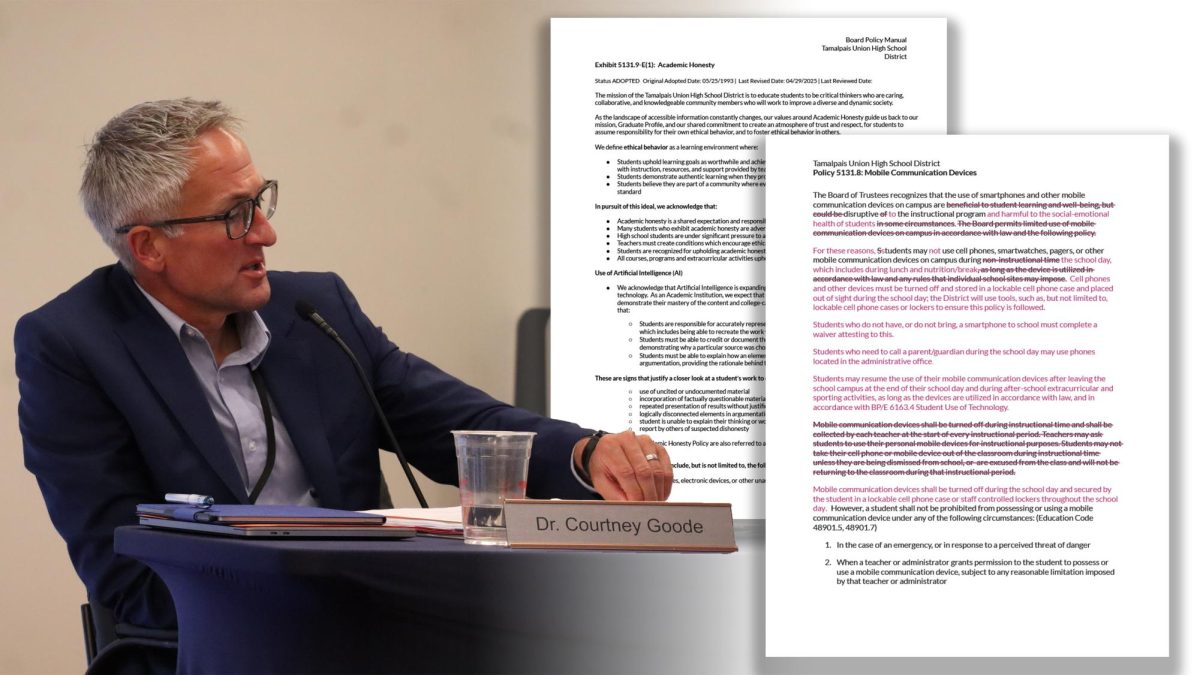
![Assistant Superintendent of Business and Operations Corbett Elsen presented an updated budget proposal for the 2026-27 fiscal year to the Tamalpais Union High School District (TUHSD) board of trustees on Tuesday, June 16.
Elsen presented an in-depth analysis of the district’s revenues, expenditures, future outlooks and the global and economic uncertainties affecting the district's revenue due to inflation and the war in Iran.
Because TUHSD is a basic-aid district, Elsen explained the significance of the housing market, stressing the gravity of the district’s financial situation as a result of lower demand.
“This is the bread and butter of our revenue: property tax revenues, [projected] to bring in over $93 million,” Elsen said, adding, “But ... we have decreased our revenue growth rate [projections].”
Elsen will return to the board of trustees on June 23, where the board will take formal action to adopt the proposed budget. To learn more about the updated budget proposal from the meeting, visit the June 16 TUHSD Gamut Online agenda.](https://redwoodbark.org/wp-content/uploads/2026/06/snapshot-1200x675.png)